
You’re running a business and security probably isn’t your top priority until something gets nicked or someone breaks in. Then suddenly it’s everything. This security guard checklist for UK business owners covers what you actually need to check when you’re hiring security guards or managing security for your premises.
Before Hiring Security Guards in the UK, Check These 16 Things
-
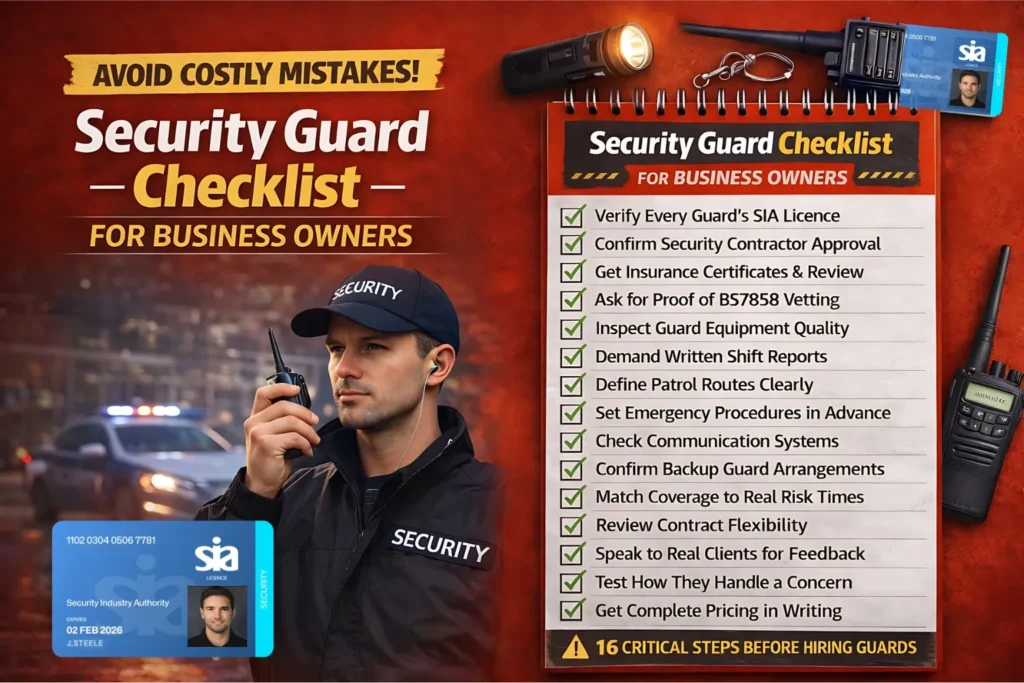
Check every single guard’s SIA licence yourself, don’t just trust what the company tells you. I mean actually look at the physical licence card. Photo should match the person standing in front of you. Expiry date needs to be months away not next week. You can verify the licence number on SIA’s website, takes maybe 90 seconds. We’ve seen businesses get burned because they assumed guards were licenced. Company said they were. Turned out three guards hadn’t renewed their licences in over a year. Business faced potential prosecution for using unlicensed security. Not worth the risk when hiring SIA licensed security guards.
-
Verify the security company itself has SIA approved contractor status separately from guard licences. This trips people up constantly. Individual guards being licenced doesn’t mean the company is approved. Company needs its own approval. SIA website has a register you can search. Takes two minutes. Companies operating without approval are breaking the law. You’re liable for using them even if you didn’t know.
-
Get copies of current insurance certificates and actually read the dates and coverage amounts. Don’t just accept “yes we’re insured.” Ask for certificate copies. Public liability should be £5 million minimum, £10 million is better. Check the dates. Some companies show you expired certificates hoping you won’t notice. One client showed us a certificate that looked fine until we checked the dates. Expired 18 months earlier. Company had been operating without insurance that whole time.
-
Request proof of BS7858 vetting for any guard who’ll have access to your property. This is way more thorough than basic criminal checks. Employment history, identity verification, address confirmation, gaps explained. Guards get unsupervised access to your building. You need to know they’ve been properly screened. Ask to see the actual vetting documentation not just verbal assurances it happened.
-
Look at what equipment guards actually show up with before their first shift. Professional torch or cheap rubbish from Poundland? Proper two-way radio if there’s multiple guards? Hi-vis gear? We replaced a company once where guards arrived with mobile phone torches and personal phones for communication. That’s not professional security, that’s someone in a uniform pretending.
-
Make sure you’re getting written shift reports after every single guard shift. What did they check? Find anything concerning? Any incidents? Photos of problems? These reports should arrive same day or next morning, not three days later when the guard finally gets round to writing them up. Reports create accountability. Without them you’ve got no idea if guards are even doing their jobs.
-
Write down exactly what areas guards should patrol and how often. Vague “patrol the building” instructions lead to guards doing whatever they fancy. Document specific routes. Check the loading bay every 30 minutes. Walk the perimeter every hour. Inspect car park twice per shift. Creates clear expectations both parties understand.
-
Set up at least two different ways to contact guards during their shifts. Mobile phone is obvious. But what if there’s no signal or their battery dies? Two-way radio as backup. Or site phone. Communication failures during emergencies are disasters. Test everything before guards work their first shift.
-
Create written procedures for different emergency situations before guards need them. Fire response, break-in in progress, medical emergency, suspicious package. Guards should know exactly what to do without having to ring you at 3am asking for instructions. Who do they call? When do they call police? How do they secure areas? Write it all down.
-
Match guard coverage times to when your actual problems happen. Getting broken into every Friday night? That’s when you need guards, not Tuesday afternoon when nothing ever happens. Don’t waste money covering low-risk periods. One warehouse we work with gets hit repeatedly during Sunday mornings. That’s when we focus their coverage. Analyse your risk patterns.
-
Ask what happens if your regular guard calls in sick or goes on holiday. Does the company have backup guards ready who know your site? Or will they scramble trying to find anyone available that morning? Your building shouldn’t sit unprotected because one guard caught flu. Backup capability separates professional companies from cowboys.
-
Read the contract terms about changing or cancelling service. Your needs change. Can you reduce guard hours with a week’s notice? Month’s notice? Are you locked in for a year? What happens if you need to cancel because your business closes or moves? Rigid contracts become nightmares when circumstances change.
-
Ring their other clients and ask honest questions about guard quality and reliability. Don’t just read testimonials on their website. Get actual phone numbers of businesses using their security right now. Call them. Ask about problems, incident handling, whether guards actually show up on time, if they’d hire the company again. You’ll learn more in a five-minute phone call than from an hour of sales pitch.
-
Test how they handle a problem during the hiring process. Raise a concern or ask a complicated question. See how they respond. Get defencive? Make excuses? Or handle it professionally? That tells you how they’ll behave when real issues arise after you’ve signed contracts. We’ve seen companies all friendly during sales then impossible to deal with once they’ve got your money.
-
Get complete pricing in writing with every possible charge listed. Hourly rate, equipment fees, setup costs, admin charges, everything. Some companies hide charges that suddenly appear on invoices later. “Oh that’ll be £50 monthly for radio rental we forgot to mention.” Get it all documented upfront. Compare total costs not just headline hourly rates.
-
Check if guards will be the company’s own employees or subcontracted from somewhere else. Subcontracting isn’t always bad but you need to know. Who actually employs the guards? Who verifies their licences and vetting? Where does accountability sit? Direct employees usually mean better control and consistency. Subcontractors can be a quality lottery.
Ring Guard Mark Security on 03301755786 for proper business security. We provide SIA licenced guards who’ve been thoroughly vetted, arrive with professional equipment, and actually do the job properly. We cover Yorkshire and Greater Manchester. Email [email protected] if you want a quote.