Why outsourcing keyholding protects your staff, satisfies your insurer, and costs less than you think
- What Professional Keyholding Services Actually Deliver
- Response Time: Professional Keyholding vs Internal Staff — The Real Numbers
- Legal Liability: The Risk Your Business Cannot Afford to Ignore
- The Real Cost Comparison: What Internal Staff Keyholding Actually Costs
- Training and Competence: What SIA-Licenced Keyholders Do That Internal Staff Cannot
- Key Security and Custody: Where Internal Arrangements Break Down
- Business Continuity: Why Internal Keyholding Arrangements Are Fragile
- How to Switch to Professional Keyholding Services: What to Expect
- Frequently Asked Questions
- Ready to Switch to Professional Keyholding Services?
A lot of UK businesses still use their own staff as keyholders. The operations manager takes the keys home. When the alarm triggers at 2am, they drive to the premises, check the building, reset the alarm, and drive back. No monthly fee. Seems sensible.
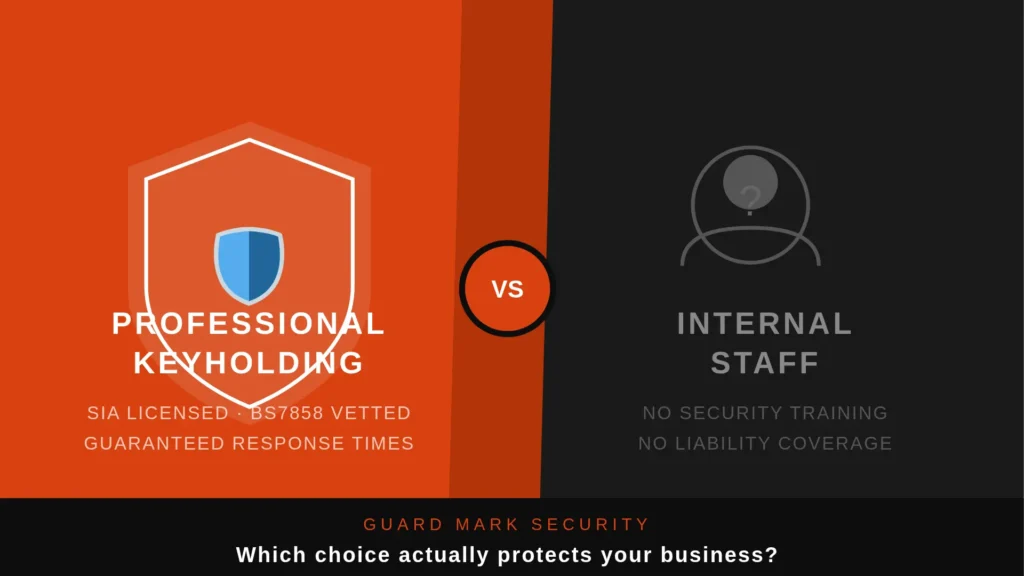
It is not sensible. It is a legal liability, an insurance risk, a staff retention problem, and in most cases it is actually more expensive than professional keyholding services, once you run the real numbers.
This guide breaks down the genuine differences between outsourcing to a professional keyholding company and using internal staff: response times, legal exposure, insurance compliance, real costs, and what happens when something goes wrong. If a staff member is currently listed as your keyholder, read this before your next insurance renewal.
| Professional keyholding services from Guard Mark Security start at £2.50 per day. One avoided break-in, one avoided insurance rejection, or one avoided Corporate Manslaughter Act claim pays for years of professional cover. |
What Professional Keyholding Services Actually Deliver
A professional keyholding company securely stores your premises keys and alarm codes in an encrypted, access-controlled facility. When your alarm activates, a trained, SIA-licenced operative is dispatched immediately — every time, within a contractually guaranteed response window, without waiting for a callback.
A complete professional keyholding service covers:
-
24/7/365 alarm response including bank holidays, Christmas, and New Year
-
External perimeter check before any operative enters the building
-
Full internal inspection once the perimeter is confirmed clear
-
Police liaison if forced entry or a genuine incident is confirmed
-
Alarm reset and full premises securing before the operative leaves
-
Written incident report delivered to you after every single attendance
-
Encrypted key storage with a full, auditable access trail
-
Lock and unlock services if your premises require daily opening and closing
Response Time: Professional Keyholding vs Internal Staff — The Real Numbers
What a professional keyholding service guarantees
Professional keyholding companies have SIA-licenced operatives on duty around the clock, every day of the year. When your alarm activates the response is immediate, the operative is already awake, already mobile, responding as part of their live duty shift. There is no delay while someone wakes up and debates whether to attend.
Guard Mark Security guarantees contractual response times specific to your premises address, agreed in writing before the service begins. Backup cover exists: if one operative is handling another callout, a second operative responds. Your alarm does not wait in a queue.
What internal staff actually deliver at 2am
Your keyholder manager lives wherever they chose to live, which may be 15 minutes or 45 minutes from your premises. When an alarm triggers at 2am, they are asleep. By the time they have woken, dressed, and driven to your site, 30 to 50 minutes have typically passed. If they are on holiday, a substitute covers, who may live further away, know the premises less well, and respond even more slowly.
Staff get sick. They resign. They are in meetings when alarms trigger during business hours. Availability is always personal, never guaranteed.
| In most break-ins, thieves are in and out within 4 to 8 minutes. A 45-minute internal staff response does not interrupt a theft — it discovers one. Professional keyholding changes that equation. |
Legal Liability: The Risk Your Business Cannot Afford to Ignore
The Corporate Manslaughter Act 2007 — and why it applies directly to keyholding
Under the Corporate Manslaughter and Corporate Homicide Act 2007, businesses have a duty of care to staff that extends to reasonably foreseeable risks of their working activities. Directing a staff member to attend a commercial premises alone at 2am, in response to an active alarm that may indicate an ongoing break-in — creates precisely this kind of foreseeable physical risk.
If that staff member is assaulted or injured, and it can be shown you directed them to attend without proper training, without backup, and without risk assessment, you and potentially the business entity face prosecution. Criminal penalties include unlimited fines and, for individuals, imprisonment. This is not a theoretical risk, UK courts have prosecuted employers under this Act for comparable situations.
| LEGAL EXPOSURE This risk is real, it is documented in case law, and it is entirely avoidable. Professional keyholding removes the need to direct any staff member to attend an alarm callout, and removes the associated liability from your business. |
Insurance liability when internal staff respond to alarms
Many commercial property insurance policies contain conditions requiring a professional, SIA-licenced keyholder for after-hours cover. If your policy contains this condition and you are using an internal staff member, you may have been in breach without knowing it. A break-in claim under those circumstances can be reduced or rejected, regardless of the validity of the loss.
Your staff member’s role is also not insured for security incident response. If they are injured during a callout, whether your employer’s liability cover responds cleanly is not guaranteed when they were performing tasks outside their contracted role.
How professional keyholding protects your legal position
When you use a professional keyholding company, liability for the operative’s actions during a callout sits with the security company, not your business. The company carries its own public liability, employer’s liability, and professional indemnity insurance. You are not the first party in the frame if something goes wrong during a response.
Professional keyholding also gives your insurer exactly what it needs: SIA-licenced operatives, BS7984-compliant procedures, documented response times, and written incident reports. That documentation supports claims and, for many insurers, qualifies your business for improved premium terms.
The Real Cost Comparison: What Internal Staff Keyholding Actually Costs
The assumption that internal staff keyholding is free is wrong once you calculate actual costs. Here is how the numbers work.
Hidden costs of internal staff as keyholders
-
Out-of-hours alarm response typically qualifies as overtime. Three callouts per month at 3–4 hours each equals 9–12 overtime hours at time-and-a-half or double-time rates.
-
Fuel and vehicle reimbursement adds up across every callout, every month, every year.
-
Staff burnout and increased turnover risk. Operations managers called out repeatedly at night look for jobs without keyholding duties. Recruitment and training replacements costs thousands.
-
Rekeying costs when keyholders leave. You should rekey when a keyholder resigns, that is £300 to £1,500 depending on the number of access points.
-
Uninsured loss risk. If a claim is rejected because your internal keyholder arrangement did not meet policy conditions, the cost of that rejection dwarfs years of professional keyholding fees.
What Guard Mark Security professional keyholding costs
Guard Mark’s professional keyholding services start at £2.50 per day, approximately £76 per month or £912 per year. No separate callout fees. Every alarm response attendance included.
| Service | Guard Mark price | What is included |
| Keyholding & alarm response | From £2.50/day | 24/7 SIA-licenced response · No callout fees · Written reports · Encrypted key storage · Police liaison |
| Manned security guarding | From £16.89/hr | SIA-licenced · BS7858-vetted · Shift reports · Full public liability |
| Mobile patrol visits | From £25/visit | GPS-confirmed · Perimeter checks · Patrol report |
| CCTV tower hire | From £28.89/day | 360° solar-powered · 4G · Remote app viewing · 24/7 monitoring |
| Door supervision | From £19.89/hr | SIA door supervisor licence · Conflict management · Event cover |
| COST REALITY Professional keyholding services cost less than most businesses spend on overtime and fuel reimbursement for internal staff performing the same function — and they deliver faster response, full insurance compliance, and zero legal exposure. |
Training and Competence: What SIA-Licenced Keyholders Do That Internal Staff Cannot
What professional keyholding operatives bring
Every operative providing professional keyholding holds a valid SIA licence — requiring formal training in security procedures, legal authority, use of force law, and emergency response protocols. SIA operatives have also been BS7858-vetted: full criminal record check, 5-year employment history verification, and identity confirmation.
Experienced keyholding operatives have responded to hundreds of alarm activations. They recognise the difference between a sensor fault and a forced entry. They know when to call police immediately and when to handle the situation independently. That judgement comes from training and repetition, not instinct.
What internal staff do when an alarm triggers at 2am
Your operations manager knows your specific building. That is their advantage. But knowing one building does not produce the broader alarm response competence that genuine incidents require.
When they arrive and find a broken window at 3am, they are making decisions without training: is this forced entry or storm damage? Is someone still inside? Should they enter or call police? If they get it wrong, entering while an intruder is present, the consequences can be serious. And a thorough inspection by someone woken from sleep, who wants to go home, is rarely as thorough as it needs to be.
| Capability | Internal staff keyholder | Professional keyholding service |
| SIA licence | None | Required — publicly verifiable on SIA register |
| Security training | None relevant to alarm response | Completed — SIA standard |
| BS7858 vetting | Standard employment check only | Full 5-year history, criminal record, identity |
| Response time guarantee | None — depends on where they live | Contractually guaranteed per premises address |
| Insurance for alarm response | Not covered under standard employment | Full public liability — company bears liability |
| Incident reporting | Informal or none | Written report after every attendance, time-stamped |
| Police liaison | Untrained, no protocol | Standard procedure for all confirmed incidents |
| Bank holiday availability | Depends entirely on the individual | Guaranteed — no exceptions, 365 days |
Key Security and Custody: Where Internal Arrangements Break Down
How professional key storage works
Your keys are stored in an encrypted, access-controlled electronic cabinet at a secure, staffed facility. Every key removal and return is logged automatically, who accessed them, when, and for which callout. You can request that audit trail at any time. Your keys never go to an operative’s home. If keys are ever lost or compromised, the keyholding company handles rekeying costs through their own insurance. Clear responsibility, no ambiguity.
The real risks of keys at a staff member’s home
Your manager takes your premises keys home. They sit wherever is convenient , possibly secure, possibly not. There is no standard and no audit trail. If they lose them, you pay for rekeying. If they resign, you face the question every business owner in this situation faces: did they return all copies? Were duplicates ever made? Many businesses rekey routinely when a keyholder leaves, simply because they cannot be certain.
When that keyholder goes on holiday, someone else holds the keys temporarily. That substitute may live further away, know the premises less well, and be even less willing to respond at 3am. That coverage gap is a security gap.
Business Continuity: Why Internal Keyholding Arrangements Are Fragile
Internal staff keyholding arrangements are fragile because they depend entirely on specific individuals. Professional keyholding services are resilient because they do not.
When your keyholder manager resigns, and people do resign, your security arrangement breaks down immediately. Someone else needs keys, codes, a site briefing, and enough goodwill to respond at 3am. That transition always has a gap. During that gap, your premises has no reliable out-of-hours cover.
With a professional keyholding company, none of this applies. The service continues through any personnel change, on your side or theirs. Your contract guarantees the service level. You are not managing a person. You are holding a service contract.
| One client’s keyholder manager resigned on a Friday. By Monday, three alarm activations had occurred over the weekend — attended by an untrained colleague who happened to still have a key. None were properly documented. Two involved perimeter breaches that went uninvestigated. Guard Mark took over keyholding that Tuesday. |
How to Switch to Professional Keyholding Services: What to Expect
Transitioning from internal staff to a professional keyholding company is straightforward. Guard Mark Security can have your premises covered within 48 to 72 hours for most sites in Yorkshire and the North.
-
Initial site visit — we photograph your premises, document access points, and record alarm system details
-
Key and code handover — provided directly to our operative during the site visit
-
System setup — premises details entered into our secure dispatch system and briefed to our operative team
-
Contract sign-off — response times confirmed for your address, service terms agreed in writing
-
Live from day one — our operatives respond to activations from the same day keys are received
| FLEXIBLE SCHEDULING If you only need professional keyholding outside business hours, or only at weekends, Guard Mark Security offers fully flexible cover schedules. You pay for the coverage you actually need, not a standard package that includes hours your staff are already on site. |
Related Articles:
Keyholding Services for Property Managers | 24/7 Alarm Response
Why Bradford Businesses Need Keyholding and Security Guard Services
Why Leeds Businesses Need Keyholding and Security Guard Services
Frequently Asked Questions
1- What is the difference between professional keyholding services and using internal staff?
Professional keyholding services mean a licensed, insured security company holds secure copies of your premises keys and responds to alarm activations on your behalf — 24 hours a day, every day of the year.
Unlike internal staff, professional keyholders are SIA-licenced, BS7858-vetted, trained in alarm response procedures, backed by professional liability insurance, and committed to contractually guaranteed response times with full written documentation for every attendance.2- How much do professional keyholding services cost compared to internal staff?
Guard Mark Security’s professional keyholding starts at £2.50 per day, approximately £76 per month or £912 per year, with no separate callout fees. Internal staff arrangements typically cost significantly more when you properly account for overtime pay, fuel reimbursement, staff burnout and turnover, rekeying costs, and the risk of an insurance claim being rejected due to non-compliant keyholding arrangements.
3- Is there a legal requirement to use professional keyholding?
There is no universal statutory requirement for all businesses. However, many commercial insurance policies require professional keyholding as a policy condition, and directing employees to attend alarm callouts alone creates real exposure under the Corporate Manslaughter and Corporate Homicide Act 2007. The combination of insurance compliance risk and legal duty of care makes professional keyholding effectively necessary for most UK commercial businesses.
4- What happens during a professional keyholding alarm response?
A trained SIA-licenced operative is dispatched immediately on alarm activation. They complete a full external perimeter check before entering. If signs of active intrusion are found, police are contacted before anyone enters. Once the premises is confirmed clear, a full internal inspection takes place, the alarm is reset, the building is fully secured, and a written incident report is produced and delivered to you.
5- Can we get professional keyholding only for certain hours?
Yes. Guard Mark Security offers flexible keyholding schedules tailored to your operations. If you need cover only outside business hours, only at weekends, or only during specific periods, we configure coverage accordingly. Pricing adjusts to the hours you select. Temporary extensions, for holiday periods, for example , can also be arranged with short notice.
6- How quickly can Guard Mark take over keyholding from our current internal arrangement?
For most premises, professional keyholding can be live within 48 to 72 hours of initial contact. Emergency transitions, due to staff resignation, an insurance requirement, or an immediate security concern, have been completed in 24 hours. Once keys are in our secure facility, our operatives respond from that same day.
7- What accreditations should I verify before choosing a keyholding company?
Every operative must hold a valid SIA licence, verifiable on the SIA public register. The company must hold SIA Approved Contractor Scheme (ACS) status. All operatives should be BS7858-vetted. The company should carry public liability insurance of at least £5 million. Operatives should follow BS7984-compliant procedures. Guard Mark Security meets all of these standards, ask us for documentation on any point before signing.
Ready to Switch to Professional Keyholding Services?
If your business currently uses an internal staff member as its keyholder, the question is not whether professional keyholding is better, the case is clear. The question is whether you make the switch before something goes wrong or after.
The cost is lower than most businesses expect. The legal protection starts immediately. The insurance compliance is clean. And you and your staff will never be woken up at 2am again.