Costs, Legal Requirements, and What Actually Protects a Real Business in 2026
Leeds is the third most dangerous major city in England, Wales, and Northern Ireland. Its overall crime rate sits 51% above the national average. Commercial burglary, organised theft, and after-hours break-ins are not edge cases — they are a regular cost of doing business in this city, unless you plan for them.
This post breaks down what that risk actually looks like, what professional security costs in Leeds in 2026, what the law requires of you as a business owner, and what combinations of services genuinely reduce your exposure. No filler. No jargon. Just what you need to make an informed decision.
| Prevention costs a fraction of what recovery costs. A single overnight break-in costs a Leeds business between £5,000 and £30,000 once you count stock loss, glazing, insurance excess, and disruption. |
The Security Picture in Leeds Right Now
The numbers are not reassuring. According to CrimeRate, Leeds recorded 112 crimes per 1,000 residents in 2025 — 30% above the Yorkshire and Humber regional average. Crystal Roof’s analysis puts the overall rate at 135 crimes per 1,000 residents, rated 7 out of 10 for severity nationally.
residents
average
residents
city
The Crime Categories that Hit Leeds Businesses Hardest
Not all crime affects businesses equally. The categories with the most direct commercial impact are:
-
Commercial burglary — rated 8 out of 10 for severity compared to other areas in England and Wales, recorded at 7.35 per 1,000 residents
-
Vehicle crime — 7.25 per 1,000 residents, particularly affecting businesses with car parks, delivery yards, and fleet vehicles
-
Shoplifting and retail theft — continuing to rise across Leeds city centre and major retail parks
-
Warehouse and industrial estate theft — increasingly organised, targeting stock, copper, and plant equipment
The Highest-Risk Areas for Leeds businesses
Some parts of Leeds carry significantly higher risk than others. Areas like Little London, Woodhouse, and Hunslet sit at the top of the local crime charts. The city centre recorded over 12,000 crimes in a single 12-month period.
But risk is not limited to these well-known areas. Industrial estates in East Leeds, warehouse clusters around the M62 corridor, and retail parks on the outskirts all face targeted theft, vandalism, and break-ins. Organised criminal groups are not restricted to postcodes.
If your business operates outside normal hours, stores high-value stock, or sits in a location without a strong natural footfall after dark, the risk level goes up significantly.
Organised Criminal Groups Versus Opportunistic Thieves
Most businesses that call a security company do it after something has happened. A break-in. A theft that was bigger than expected. An insurance claim that revealed gaps in their current setup.
The reality is that prevention costs a fraction of what recovery costs. A single overnight break-in involving stock loss, glazing damage, and business disruption can cost a Leeds business anywhere between £5,000 and £30,000 when all factors are included. A professional keyholding service costs less than £2 per day. A security guard shift for overnight cover starts from around £16.89 per hour.
The economics are not complicated. Acting before an incident is always cheaper than dealing with the aftermath.
Protect your Leeds business before something goes wrong. Guard Mark Security offers keyholding from £2.50 per day and security guards from £16.89 per hour.
The distinction matters because it changes what effective security looks like. Opportunistic thieves look for an easy target of opportunity. A visible guard, a lit perimeter, or the presence of a patrol vehicle is often enough to move them on.
Organised groups operate differently. They do reconnaissance. They watch patrol patterns and identify timing gaps. They plan entries and exits. They target specific stock — copper, electronics, plant equipment, high-spec fit-out materials — and they return to premises that proved accessible the first time.
| A visible security guard or an unpredictable patrol schedule disrupts the reconnaissance phase before a plan is ever formed. Reacting after the first incident is significantly harder than deterring before it happens. |
| Protect Your Leeds Business Before Something Goes Wrong Keyholding from £2.50/day · Security guards from £16.89/hr · Call 03301755786 |
What Is Keyholding — and Why It Matters More Than Most Leeds Business Owners Realise
The Basic Idea Behind Keyholding
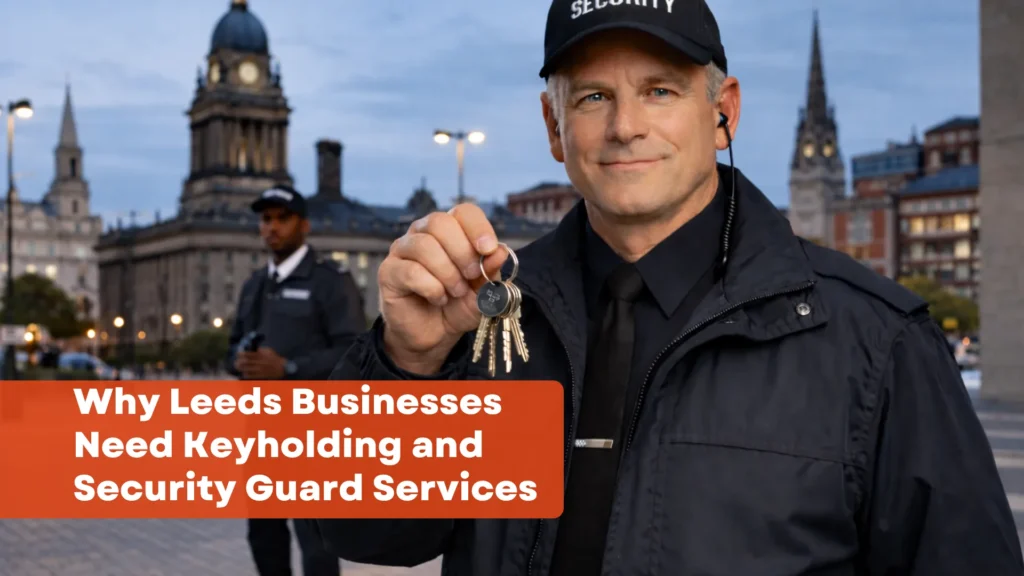
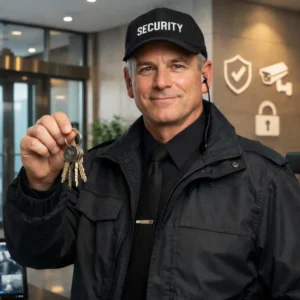
Keyholding means a professional, SIA-licenced security company holds a copy of your keys and responds to alarm activations on your behalf, 24 hours a day, 7 days a week, including bank holidays.
When your alarm triggers at 2am on a Sunday, you are not the one driving to the premises. A trained operative goes instead. They check the building, deal with the situation, liaise with police if needed, reset the alarm, and send you a written incident report before your team arrives in the morning.
This matters more than most business owners realise until they have been the one getting the 3am call.
| 3am The most common hour for commercial alarm activations in the UK Health and Safety Executive data |
What Professional Keyholding Covers Day to Day
Professional keyholding is not just about alarm response. A properly structured service includes:
-
Rapid attendance when alarms activate, day or night, any day of the year
-
External and internal premises checks after activation
-
Full internal premises check — compound, offices, accessible structures
-
Police liaison when an incident is confirmed or signs of forced entry are found
-
Alarm reset and premises secured before the operative leaves
-
Full written incident report after every callout
-
Secure storage of your keys in encrypted systems
-
Locking and unlocking if you need daily open/close managed
At Guard Mark Security, keyholding starts from just £2.50 per day. That covers alarm response as part of the service. There is no separate charge for alarm callouts on top of keyholding because, at Guard Mark, the two come as one package.
Why Being Your Own Keyholder Creates Problems
A lot of Leeds business owners are listed as the keyholder on their own alarm system. That means every activation, every false alarm, and every genuine break-in attempt calls them directly. That arrangement has four serious problems:
| The problem | What it actually means | The professional solution |
|---|---|---|
| Response time | Most owners cannot attend within the 20-minute window many insurers expect. A 45-minute response on a genuine break-in means the intruders are long gone. | Guard Mark operatives respond within a contractually agreed window, specific to your premises address. |
| Physical safety | Attending a commercial property alone at night in response to a triggered alarm is genuinely dangerous. If the alarm is real and people are inside, you are walking into a confrontation without support or training. | Operatives conduct an external perimeter check before entry. If there are signs of active intrusion, police are called first. Nobody enters until it is safe. |
| Legal liability | Directing an employee to attend an alarm callout may breach your duty of care under the Corporate Manslaughter and Corporate Homicide Act 2007. If they are injured, you could face prosecution. | Professional keyholding removes this liability entirely. The risk sits with the security company, not your business. |
| Insurance compliance | Many commercial policies require a professional, SIA-licensed keyholder as a policy condition. If you use a colleague or staff member and something goes wrong, your insurer can reject the claim. | A contracted, accredited keyholding service with documented incident reports gives your insurer exactly what it needs. |
| Hand Your Keys to Professionals — From £2.50/Day 24/7/365 · No callout fees · SIA-licensed operatives · Call 03301755786 |
What Security Guard Services Actually Cover for Leeds Businesses
Manned Guarding — The Most Direct form of Deterrence
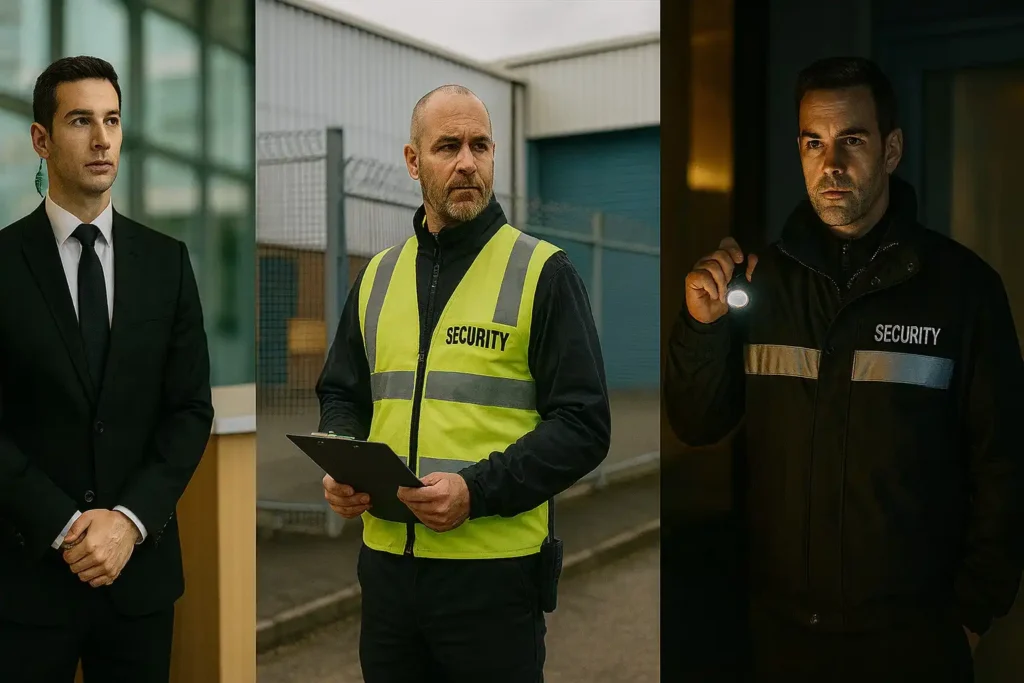
A manned security guard is a physical, visible presence on your site. This is the most direct form of deterrence available.
Guards patrol your premises, monitor access points, check credentials, report incidents, and act as the first line of response if something goes wrong. Their presence alone changes how your site is perceived by anyone considering criminal activity.
Manned guarding works well for:
-
Warehouses and distribution facilities with high-value stock
-
Construction sites during active build phases — particularly at fit-out stage
-
Retail premises during trading hours or overnight
-
Commercial offices requiring access control during and after business hours
-
Events, licensed venues, and premises with high footfall
Mobile Patrols — Cost-effective, Unpredictable, Proven
Not every Leeds business needs a full-time guard on site. Mobile patrols offer a cost-effective middle ground.
A patrol vehicle visits your premises multiple times per night at randomised times. The unpredictability of the visits is the key feature. Criminals who watch a site looking for patterns cannot identify a safe window to act when patrols arrive at different times each visit.
Patrol guards check perimeters, look for signs of forced entry, verify that doors and gates are properly secured, and report any concerns. You receive confirmation of each visit along with notes from the patrol.
Door Supervision — Legally Required, Not Optional

If your Leeds business runs events, operates a licenced venue, or regularly hosts large gatherings, SIA door supervisor licences are a legal requirement, not an optional extra.
Door supervisors have additional training in conflict management, physical intervention, and crowd control that standard security guards do not. Trying to use general security staff at a licenced venue instead of door supervisors puts your premises licence at risk.
CCTV Towers — Wide Coverage, Rapid Deployment
For construction sites, open-air storage areas, or large sites where manned guarding would need multiple guards to cover the area, CCTV towers provide wide-coverage surveillance at a fraction of the cost.
Guard Mark’s solar-powered CCTV towers offer 360-degree coverage, 4G connectivity, remote viewing through a mobile app, and 24/7 monitoring. They can be deployed quickly and repositioned as site needs change.
Legal Requirements Every Leeds Business Owner Needs to Know
SIA Licensing — Non-Negotiable
Under the Private Security Industry Act 2001, any security operative working under a contract for services must hold a valid SIA licence. This covers security guards, door supervisors, CCTV operators, close protection officers, and keyholders.
If a security company sends an unlicenced guard to your premises and you are aware of it, you share liability. The SIA licence is verifiable in seconds through the SIA’s public register. Any reputable company will encourage you to check.
Using unlicenced security is not just a paperwork issue. It can result in prosecution, it voids your insurance, and it leaves you legally exposed if anything goes wrong while that guard is on your property.
BS7858 Vetting: What it Covers and Why it Matters
BS7858 is the British Standard for vetting personnel who work in secure environments. It goes significantly further than a basic DBS check.
BS7858 screening includes:
-
Full criminal record checks
-
Employment history verification going back five years minimum
-
Identity confirmation and address history
-
Reference checks
-
Financial status review in some cases
Any guard with unsupervised access to your property should be BS7858 vetted without exception. If a company cannot confirm this standard for all their operatives, that is a serious concern.
SIA Approved Contractor Status — Individual Licences are not enough
Individual guard licences and company approval are two separate things. A company that supplies security services commercially should hold SIA Approved Contractor status. You can verify this on the SIA’s public register.
A company without this approval is operating outside the regulatory framework, regardless of whether their individual guards hold licences. For Leeds businesses that need documentation for insurance or compliance purposes, SIA Approved Contractor status is a basic requirement.
Insurance Requirements for Security Arrangements
A professional security company should carry public liability insurance of at least £5 million, with £10 million preferred for higher-risk sites.
Your own business insurance may also have specific security conditions. Some policies require professional keyholding as a policy condition. Some require guaranteed response time documentation. Some require specific vetting standards for anyone with access to your premises. If your security arrangements do not meet your insurer’s requirements, a claim following a break-in can be reduced or rejected entirely.
| The cost of a rejected insurance claim following a major break-in is always far greater than the annual cost of a compliant keyholding service. Read your policy conditions before an incident — not after. |
How Much Does Security Actually Cost in Leeds in 2026
Security Guard Hourly Rates in Yorkshire
| Service | Guard Mark pricing | What is Included |
|---|---|---|
| Keyholding & alarm response | From £2.50/day | 24/7/365 response · No callout fees · Written incident report every attendance · Encrypted key storage |
| Manned security guarding | From £16.89/hour | SIA-licensed · BS7858-vetted · Shift reports · Public liability insurance |
| Mobile patrol visits | From £25/visit | GPS-confirmed attendance · Perimeter checks · Door and gate verification · Patrol report |
| CCTV tower hire | From £28.89/day | 360° coverage · Solar powered · 4G · Remote app viewing · 24/7 monitoring |
| Door supervision | From £19.89/hour | SIA door supervisor licence · Conflict management training · Event and venue cover |
| K9 security | From £19.89/hour | Handler and dog · NASDU standards · Deterrence and active search |
The real cost of a single commercial break-in
Business owners who compare security costs in isolation rarely factor in what a single incident actually costs. A standard overnight commercial break-in in Leeds, once you account for all factors, costs:
Repeat targeting — premises that have been broken into once are significantly more likely to be targeted again
-
Stock loss — typically £2,000 to £15,000 depending on sector
-
Emergency glazing and boarding — £500 to £2,500
-
Lock and alarm system repair or replacement — £300 to £1,500
-
Insurance excess — £500 to £5,000 depending on policy
-
Business disruption — loss of trading, staff time, management distraction
-
Insurance premium increase following a claim — ongoing cost for 3 to 5 years
What Cheap Security Actually Costs You
There is always a cheaper option available in any market. The risk with cheap security is that you do not find out what you paid for until something goes wrong.
Low-cost providers cut costs somewhere. That might be through vetting shortcuts, subcontracting to unchecked guards, using drivers rather than properly trained security operatives for patrols, or offering response time windows so wide they are useless during an actual incident.
When an insurance claim is submitted after a break-in and the insurer asks about your security arrangements, what your contract says and what was actually delivered can be very different things. The costs of a rejected claim, a gap in documented security procedures, or an injury involving an unvetted guard are always far higher than what you saved on the contract.
Best Practises for Leeds Business Security
Start With a Proper Risk Assessment
Before choosing any service, understand what your actual risk looks like. A good security company should conduct or assist with a site-specific risk assessment before recommending anything.
Key questions to work through:
-
What are your most vulnerable access points?
-
What times are your premises most exposed?
-
What is the value of assets on site overnight?
-
What does your insurance require?
-
Have you had any previous incidents, attempted break-ins, or suspicious activity?
The answers shape the right combination of services. Some Leeds businesses need guards. Some need keyholding. Some need both. Some need patrols three nights a week and full cover at weekends. There is no universal answer.
Verify Everything Before You Sign Anything
When evaluating a security company, the following are non-negotiable:
-
Confirm SIA Approved Contractor status on the SIA register
-
Ask to see individual guard licence numbers and verify them
-
Request proof of BS7858 vetting for all personnel who will access your site
-
Get a copy of their public liability insurance certificate and check the dates and coverage amounts
-
Ask for a clear written contract with guaranteed response times
-
Request references from existing clients in similar industries
Do not take verbal assurances on any of these points. Legitimate companies have no problem providing documentation. Companies that become evasive when asked for proof are telling you something important.
Get Response Times in Writing
Response time guarantees mean nothing unless they are written into your contract with clear consequences if they are not met.
For alarm response in Leeds, a professional provider should be able to commit to response within a specific window based on your location. That time should be clearly stated, not described in vague terms like “as quickly as possible.”
A response time guarantee in writing is also useful evidence for your insurer if a claim ever needs to be supported with documentation of your security arrangements.
Brief Your Staff Properly
Security systems only work when the people using them understand them. Common causes of false alarms and security failures include:
-
Staff forgetting alarm codes after holidays
-
New employees not being briefed on access procedures
-
Cleaners or contractors triggering alarms because procedures were not communicated
-
Managers not knowing who to call when something happens
Create a short written briefing document for all staff covering alarm procedures, emergency contacts, what to do if they discover a problem, and who the keyholding company is. Review it whenever personnel change.
Review Your Security Regularly
A security setup that worked well when your business was smaller or in a different location may not be adequate as your business grows or your risk profile changes.
Schedule a security review at least once a year. Look at incident logs, patrol reports, and any near-misses or concerns raised by staff. Ask your security provider whether your current level of service still matches your current risk.
Leeds’s crime landscape changes, and your security should adapt with it.
Combine Services for Layered Protection
Single-layer security is easier to defeat than layered protection. A business that relies only on an alarm system and nothing else is betting everything on that one measure working correctly every time.
Professional security works best when services reinforce each other. Keyholding ensures rapid alarm response. Mobile patrols provide unpredictable visible deterrence. A CCTV system creates a deterrence signal and an evidence trail. Static guards handle access control and visible presence during high-risk periods.
You do not need every service to start with. But understanding how they work together helps you build toward a setup that genuinely protects your business rather than one that just checks a box for your insurer.
For most Leeds businesses, a practical starting point is keyholding with alarm response. From there, adding mobile patrols on high-risk nights or a static guard during specific vulnerable periods creates meaningful additional layers without immediately committing to a full-time security contract.
Keep Documentation Current
Security documentation is not just a compliance exercise. It is evidence of your duty of care if an incident occurs and a claim or legal question follows.
Maintain current records of:
-
Your security company’s SIA Approved Contractor status
-
Individual licence numbers for guards regularly attending your site
-
Insurance certificate copies with current dates
-
Signed contracts with response time commitments
-
Patrol and incident reports from every attendance
When an insurer reviews a claim or a legal question arises after an incident, the business with complete documentation is in a fundamentally stronger position than one that has verbal agreements and no paper trail.
Need a security company in Leeds you can trust on paper and in practise? Guard Mark Security provides full documentation, written contracts with clear response time guarantees, and SIA-approved services backed by insurance. Call 03301755786 or email [email protected].
Quick Guide by Sector — What Works Best for Your Business Type
| Business type | Primary risk | Recommended starting point |
|---|---|---|
| Retail — city centre or retail park | Shoplifting, after-hours break-ins, repeat targeting | Keyholding + alarm response. Add static guard or patrol for high-value stock or persistent issues. |
| Warehouse / industrial | Organised theft of stock, copper, vehicles. Large footprint hard to cover with one measure. | Keyholding + mobile patrol. CCTV tower for very large sites. Static guard for highest-value windows. |
| Construction site | Phased risk — plant/fuel at groundworks, copper at active build, fixtures at fit-out. Organised groups specifically target sites. | Keyholding covers compound. CCTV tower for site-wide coverage. Mobile patrol adds deterrence. |
| Licenced venue / event space | Door supervision is a legal requirement, not a choice. | SIA door supervisors as baseline. Keyholding for premises outside event hours. |
| Corporate office | Access control, visitor management, after-hours cover. | Keyholding for out-of-hours. Reception security or manned guarding business hours. |
| Vacant or landlord property | Squatting, vandalism, fly-tipping — all create insurance complications. | Regular vacant property checks with written reports. Keyholding if alarm system in place. |
The Most Common Security Mistakes Leeds Businesses Make
1- Choosing Price Over Compliance
The most common mistake is choosing the cheapest option without verifying what it actually delivers. Low hourly rates look attractive until you discover that guards are not properly vetted, response time guarantees are not contractually binding, or the company does not hold SIA Approved Contractor status.
The liability that comes with uncompliant security sits with you as the business owner, not just with the company you hired.
2- Not Updating Security When the Business Changes
A security setup designed for a smaller premises or a different level of stock does not automatically scale up when your business grows. Many Leeds businesses experience this quietly over time. They expand, take on more stock, extend their operating hours, or take on more staff, but their security arrangements stay the same as they were three years ago.
If your business has changed significantly in the last two years, your security arrangements probably need reviewing.
3- Assuming Alarm Systems Are Enough
Alarms alert. They do not respond. A triggered alarm that reaches a voicemail or a sleepy business owner who takes 45 minutes to decide whether to drive in is not a security system. It is a recording device that tells you something happened after it happened.
Professional keyholding converts your alarm from a passive notification into an active response. That difference is what professional security actually means.
4- Not Reading the Contract Before Signing
Security contracts vary significantly in what they commit to. Some response time guarantees have so many exceptions written in that they are essentially meaningless. Some contracts auto-renew on long terms without clear notice. Some have penalty clauses for early termination that make switching providers expensive.
Read the contract before signing. Ask specifically about response time commitments, notice periods for cancellation, what happens if a guard calls in sick, and how incidents are documented and reported. A company that gives clear, direct answers to these questions is worth more than one that deflects or uses vague language.
Frequently Asked Questions
1- How Much does Keyholding Cost for a Leeds Business?
Guard Mark Security keyholding starts from £2.50 per day. That includes 24/7/365 alarm response with no separate callout fees and a written incident report after every attendance. Contact us for a quote specific to your premises and requirements.
2- Is Keyholding a Legal Requirement for Commercial Premises in Leeds?
It is not a statutory legal requirement for all businesses. However, many commercial insurance policies require professional keyholding as a policy condition for after-hours cover. S
ending an employee to attend an alarm callout alone may also create liability under the Corporate Manslaughter and Corporate Homicide Act 2007 if that employee is injured. The legal risk of not having professional keyholding is higher than most business owners realise.3- What is the difference between Keyholding and a Security Guard?
Keyholding means the security company holds your keys and responds to alarm activations — they attend when something happens. A security guard is a physical presence on your site during an agreed period, active whether or not an alarm triggers.
Many Leeds businesses use both: keyholding for out-of-hours alarm response and a guard for periods of highest operational risk.4- Do Security Guards need to be SIA-licenced?
Yes. Under the Private Security Industry Act 2001, all security operatives working under contract must hold a valid SIA licence. You can verify any licence number on the SIA’s public register. Any reputable company will encourage you to check. A company that resists verification is a red flag.
5- Will Professional Keyholding Reduce my Business Insurance Premium?
Many commercial insurers offer reduced premiums to businesses with a professional, SIA-licenced keyholder arrangement in place. Guard Mark Security can provide documentation of our accreditations and service standards to support your insurer’s requirements. The impact on your specific policy depends on your insurer and coverage — speak to them directly with our documentation in hand.
6- How Quickly will Guard Mark Security Respond to an Alarm at my Leeds Premises?
Response times are contractually agreed for your specific premises address before the service begins. Every attendance is timed, documented, and included in the post-callout incident report. We do not offer vague response windows — we commit per address in writing.
7- Can you Cover Bank Holidays and the Christmas Period?
Yes. Guard Mark Security operates 24 hours a day, 7 days a week, 365 days a year. There are no reduced services over bank holidays, Christmas, or New Year. These are among the highest-risk windows for commercial premises in Leeds — we cover them as standard.
Ready to Protect Your Leeds Business?
The businesses that call a security company after a break-in spend more, recover slower, and face higher insurance costs for years afterward. The ones that get keyholding and security in place before anything happens spend less, sleep better, and are not starting from a deficit when the next incident might otherwise have hit them.
Guard Mark Security provides professional keyholding and security guard services across Leeds and Yorkshire. SIA-licensed operatives. BS7858-vetted. ACS-approved. From £2.50/day.
| Call Guard Mark Security: 03301755786 Email: [email protected] · Free site assessment · No obligation · 24/7 support team |