
Table of Contents
If you are looking into a professional keyholding service for your business, you will quickly come across two terms that are often used together but sometimes confused: keyholding and alarm response. Some companies treat them as the same thing. Others list them separately with different pricing. Understanding what each one actually covers, how they work together, and what you genuinely need is essential before you sign any contract.
This blog breaks down both services clearly, explains where they overlap, and helps you work out what the right arrangement looks like for your business.
What Is a Keyholding Service?
Keyholding is one of the most straightforward and underused security services available to commercial businesses. The basic concept is simple: a professional, licenced security company holds a secure copy of your keys on your behalf. What that actually delivers in practise goes much further than the simplicity of the concept suggests.
Related Article: What Are Keyholding Services? Benefits for Business Security
What Does Key Holding Actually Involve?
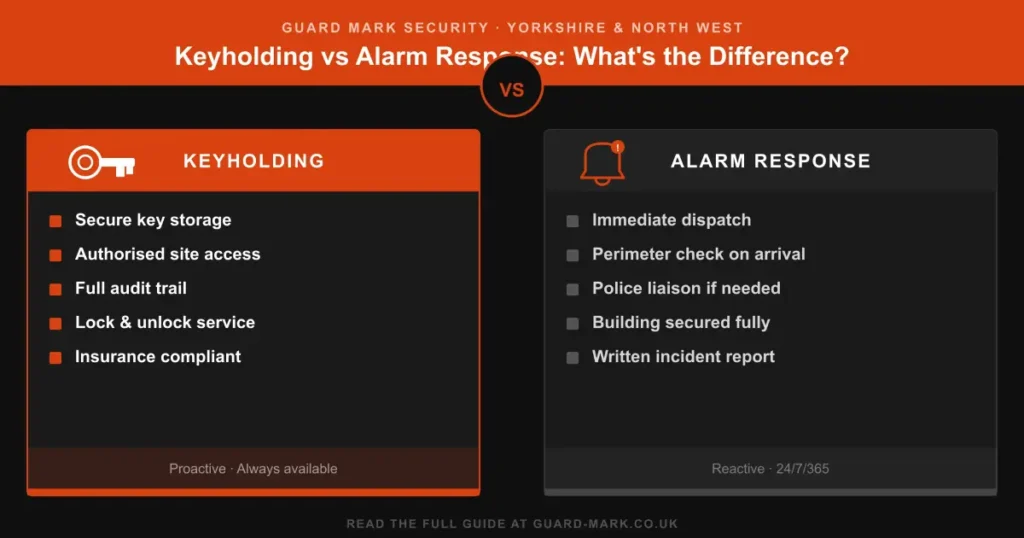
A keyholding service means that a licenced security operative has authorised access to your premises. When access is needed outside normal hours, whether due to an alarm activation, a need for locking or unlocking, or any other authorised reason, the keyholder can attend and enter the property on your behalf.
The keys are held in encrypted, secure storage when not in use. They are logged in and out against every attendance. A proper keyholding security company maintains a full audit trail of every time a key is accessed, by whom, and for what purpose. You should be able to request this record at any time.
Who Needs a Keyholding Service?
Most commercial businesses with an alarm system and premises that are unoccupied outside trading hours would benefit from keyholding services. The question is not really whether you need it. It is whether the risk of not having it is one you are comfortable carrying.
-
Warehouses and distribution centres
-
Construction sites with secure compounds
-
Office buildings and business parks
-
Manufacturing facilities
-
Any premises where an unresponded overnight incident would be costly
What Are the Legal and Insurance Implications?
Many commercial insurance policies include conditions specifying that a professional keyholder must be able to attend your premises within a defined response time — often 20 minutes. If you are still your own keyholder, you may be carrying a compliance gap without knowing it.
These policies may also require that the keyholder is a licenced, professional service rather than just a named individual. That gap only becomes visible when a claim is made and the insurer reviews whether the terms were met at the time of the incident.
What Is an Alarm Response Service?
Alarm response is the reactive element of commercial security cover. It is specifically about what happens when your alarm activates outside of normal hours. While keyholding covers authorised access more broadly, alarm response is focused on one thing: getting a trained operative to your premises quickly when your alarm goes off.
How Does Alarm Response Work in Practise?
When your alarm activates, the signal goes to a monitoring centre. The monitoring team identifies the premises, checks the activation details, and dispatches a licenced alarm response operative to attend your site. This happens immediately, without waiting for a callback, a decision, or a second activation.
The attending operative arrives at your premises, carries out an external perimeter check before entering, assesses the situation, calls police if a genuine incident is confirmed, resets the alarm if the premises are clear, secures the building fully, and sends a written incident report to you once the attendance is complete.
What Does a Good Alarm Response Look Like?
The quality of an alarm response service sits almost entirely in two things: response time and what the operative actually does when they arrive.
Response time should be contractually guaranteed — not loosely described. The contract should state a specific maximum attendance window for your premises location. Vague language like “rapid response” or “swift attendance” is not a guarantee. It is a preference.
On arrival, a properly trained operative does not walk straight in and reset the alarm. They check the perimeter first. If there are signs of forced entry, they call the police before anyone enters. The internal check follows only when the external assessment says it is safe to proceed. That sequence matters for the safety of the operative and the integrity of any potential crime scene.
How Is Alarm Response Different From Simply Having an Alarm System?
| Situation | Alarm System Only | With Professional Alarm Response |
|---|---|---|
| Alarm activates at 3am | Notification sent to you — you’re asleep | Operative dispatched immediately |
| Police coordination | You must call yourself | Handled by the operative on-site |
| Perimeter check | You attend — potentially walking into danger | Trained operative checks before entering |
| Incident report | No formal record | Written report delivered to you |
| Building secured | Depends on you attending | Full securing before operative leaves |
How Do Keyholding and Alarm Response Work Together?
In practise, keyholding and alarm response are closely connected, and most commercial keyholding services include both. The keyholding element provides the authorised access. The alarm response element provides the trigger and the reactive process. One without the other is incomplete.
Why You Need Both, Not Just One
If you have alarm response without keyholding, the responding operative has no authorised access to your premises. They can attend, check the perimeter, and call the police, but they cannot enter and check the interior unless you are also attending to let them in. That dependency removes a significant part of the value of having a professional response arranged.
If you have keyholding without a clear alarm response process, you have a company that holds your keys but no defined trigger or procedure for when and how they attend. The keys exist in secure storage, but the mechanism for deploying them is unclear.
The combination of both services, delivered by a single 24/7 keyholding service, gives you a complete cycle. The alarm activates, the monitoring team responds, the keyholder attends with authorised access, carries out the full premises check, takes any necessary action, and secures the building. That is what proper commercial keyholding services look like in practise.
What Does a Combined Service Include?
A properly structured commercial keyholding and alarm response package covers all of the following without any element being treated as an optional extra:
-
24/7/365 alarm monitoring and response, including bank holidays
-
Contractually guaranteed response times for your specific location
-
Full external perimeter check on every attendance before entry
-
Internal premises check once the perimeter assessment is complete
-
Police coordination if a genuine incident is confirmed
-
Alarm reset and full building securing before the operative leaves
-
Secure, encrypted key storage with a full access audit trail
-
Written incident report delivered to you after every attendance
-
Locking and unlocking services if your operating hours require them
If a provider is charging separately for alarm response on top of a keyholding daily rate, ask exactly what is and is not included in each element before agreeing to anything.
What Happens When Only Part of the Service Is in Place?
Gaps in the service create gaps in your protection, and those gaps tend to surface at the worst possible moment.
A business owner who is still the keyholder but has alarm monitoring in place gets the notification quickly. The response, however, depends on them. How far away they are. Whether they answer the phone. Whether they are willing to attend at 4am in winter. Whether they arrive safely to a premises where someone may still be inside.
A business with professional alarm response in place but no authorised keyholder access gets a perimeter check and a police call if needed, but no interior check and no confirmed securing of the building before the operative leaves. The service stops at the threshold.
Neither situation is the same as having a complete, properly structured 24/7 keyholding service covering both elements without dependency on the business owner.
The Real-World Scenarios Where This Distinction Matters
The difference between keyholding and alarm response can feel abstract until you look at how it plays out in real situations. The following scenarios illustrate where the gaps appear and what proper cover prevents.
A Genuine Break-In
Your alarm activates at 1am. Guard Mark’s operative is dispatched immediately, arrives within the contracted window, checks the perimeter, finds a forced rear door, and calls the police before entering. Police attend, the building is cleared, a full incident report is produced. You receive it at 7am with a clear account of everything.
Without cover: The alarm goes to you. You attend 40 minutes later, walk in through the front, have no idea whether anyone is still inside, and discover the damage yourself. You placed yourself in a genuinely risky situation.
A False Alarm
False alarms are the most common type of activation for most commercial premises. Sensor faults, staff forgetting codes, cleaning contractors triggering the system overnight. These activations all look identical to a genuine incident until the premises are checked.
A professional keyholding service attends every activation without exception. False alarm history does not affect the response. The guard checks the premises, confirms it is secure, resets the alarm, and sends the report. You find out it was nothing in the morning and go back to sleep having not been woken up or attended yourself.
Without cover: Without professional cover, each false alarm erodes your willingness to respond to the next one. The call that gets ignored because it is probably nothing again is the one that eventually is not.
An Insurance Compliance Gap
A business owner has been attending their own alarm for three years without incident. Their insurance renewal comes around and they take out a new policy without reading the keyholder conditions carefully. Six months later there is a break-in. They attend 55 minutes after the alarm activates. The insurer reviews the claim, checks the policy conditions, and notes that the required 20-minute response was not met. The claim is disputed.
This scenario is more common than most Yorkshire business owners realise. A combined keyholding and alarm response service from a licenced professional company removes this exposure entirely.
What to Look for When Choosing a Provider
Not all keyholding and alarm response providers deliver the same level of service. The market includes companies that meet every professional standard and companies that fall well short of it. Knowing what to check before signing a contract protects you from the latter.
Licencing, Vetting, and Accreditation
Every operative holding your keys and attending your premises must hold a valid SIA licence. This is a legal requirement under the Private Security Industry Act 2001 and is publicly verifiable on the SIA register. Any reputable keyholding security company will not only confirm this but will actively support you in checking it.
Beyond individual licencing, all personnel with access to your premises should be BS7858 vetted. This British Standard covers criminal record checks, five-year employment history verification, and identity confirmation. It is the recognised vetting standard for anyone with unsupervised access to commercial premises.
At company level, SIA Approved Contractor status is the mark of a provider that has passed independent audits against the SIA’s quality framework. This is publicly verifiable and represents the minimum accreditation standard for a commercial keyholding security company.
What the Contract Must Include
Before signing with any keyholding services provider, the contract should clearly state the following:
-
Guaranteed response times specific to your premises address
-
What constitutes a complete attendance and what the operative checks
-
How keys are stored and what the access audit process looks like
-
Incident reporting requirements and how quickly reports are delivered
-
Whether alarm response is included or charged separately
-
What happens if the guaranteed response time is not met
If any of these points are vague, verbal, or absent from the contract entirely, that is worth addressing before you sign.
Around £912/year for complete professional cover. One unresponded incident typically costs far more.
Guard Mark Security: Complete Keyholding and Alarm Response Across Yorkshire and North West
Guard Mark Security provides professional keyholding services and alarm response cover across Yorkshire, North West England, and surrounding areas. All operatives are SIA licenced and BS7858 vetted before attending any client premises. Guard Mark holds SIA Approved Contractor status and carries full public liability insurance.
The service runs 24 hours a day, 365 days a year, with no gaps for bank holidays, weekends, or seasonal periods. Every alarm activation is attended. Every attendance produces a written report. Response times are contractually agreed against your specific location before the contract begins.
Keyholding and alarm response are not two separate decisions. They are one complete service — and both need to be in place to give your business the protection it actually needs. If you currently have one without the other, or neither, now is the right time to sort it.
Get professional keyholding cover for your Yorkshire business.
We’ll confirm response times for your exact location before you commit to anything.
Call 0330 175 5786