
- What Happens in the First 60 Seconds after an Alarm Activates?
- What Happens When No Professional Response Is in Place?
- What Happens When a Professional Keyholding Service Is in Place?
- What Happens When the Activation Turns Out to Be a Genuine Incident?
- What Happens When the Activation Is a False Alarm?
- What to do Right Now If You Have Just had an Incident
- What Should Businesses Take Away From Understanding the Alarm Chain?
- Frequently asked questions
The moment a commercial alarm activates, a chain of events begins. What that chain looks like, and where it ends, depends entirely on what response arrangement is in place. With professional keyholding services, the chain leads to a trained operative on your premises, a secured building, and a written report in your inbox. Without them, it leads to wherever you happen to be at that hour, making decisions you are not trained to make.
This blog traces that chain from the first signal to the final resolution, across different scenarios, so you can see exactly what a triggered alarm means in practise.
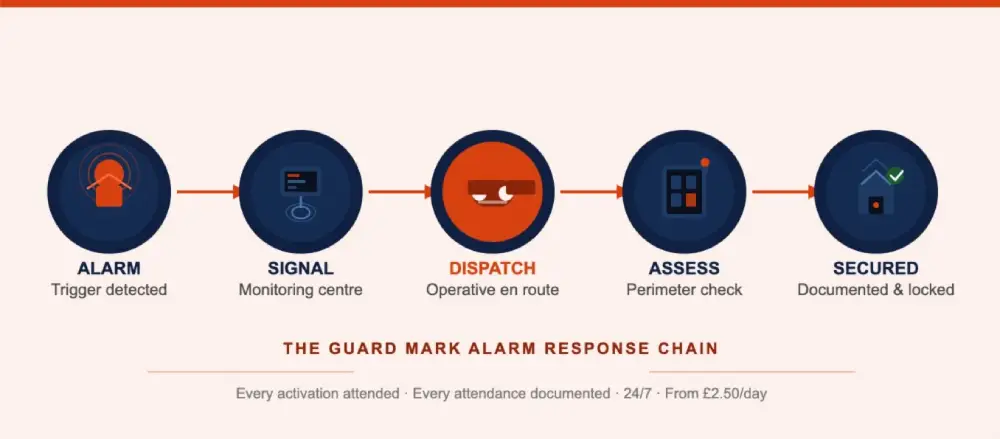
What Happens in the First 60 Seconds after an Alarm Activates?
The first minute is the most important. The alarm detects the trigger, the signal is generated, and notification is sent to whoever is connected to the system. In commercial premises, this is usually either a 24/7 monitoring centre connected to a professional keyholding service or a named individual whose phone receives the alert.
What happens next splits into two very different paths depending on which of those receivers picks up the signal.
What Does the Alarm System Actually Detect?
Modern commercial alarm systems use a combination of detection methods. Motion sensors detect movement in specific zones. Door and window contacts register when access points are opened or broken. Glass break sensors respond to the acoustic frequency of breaking glass. Panic buttons allow staff to trigger a silent or audible alarm manually.
Each of these detection methods generates an alert at the moment of trigger. The system logs the event, identifies which zone or sensor was activated, and sends the signal outward. The alarm itself does not stop an intrusion. It reports one.
What Is the Difference Between an Intruder Alarm and a Monitoring System?
An intruder alarm detects and generates an alert. A monitoring system receives that alert and initiates a response. These are two separate functions, and both need to be in place for an alarm activation to mean anything in practise.
Many businesses have the first without the second. The alarm detects activity and sends a notification that goes to a mobile phone, a voicemail, or a system log that nobody checks in real time. Until a monitoring centre is connected and a professional keyholding security company is on standby, the alarm is generating information without generating a response.
Related Article:
What Happens When a Business Alarm Goes Off at Night?
Why Property Managers Outsource Keyholding Services
Professional Keyholding Services vs. Using Internal Staff as Keyholders
What Happens When No Professional Response Is in Place?
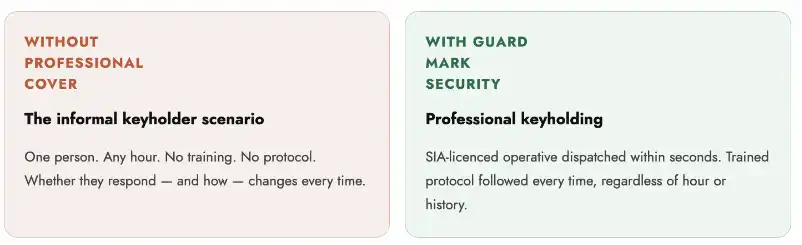
When a commercial alarm activates and the only notification goes to a business owner or named individual, the response is entirely dependent on that person. Whether they answer. Whether they can attend. Whether they are willing to drive to the premises alone at 3am. Whether they know what to do when they get there.
What Decisions Does an Untrained Keyholder Have to Make on Arrival?
When a business owner or informal keyholder arrives at a triggered premises, they face decisions immediately. Is it safe to enter? Is there any sign of forced entry? Is anyone still inside? Should they call police before going in?
These are not easy calls for an untrained person at midnight. Getting them wrong has consequences. Walking into a premises where an intruder is still present is a personal safety risk. Entering before police arrive can compromise the scene. Making the wrong decision in the first 60 seconds of an attended activation affects everything that follows.
What Does a Slow Response Allow to Happen?
Time is the resource that criminal groups are managing when they target a commercial premises. The longer between the alarm triggering and a professional response arriving, the more that window is available to use.
A warehouse that takes 90 minutes to respond to has 90 minutes of uninterrupted access available to anyone on site. A retail unit that receives a response in 18 minutes has an 18-minute window. Professional alarm response services are not just about what happens when someone arrives. They are about how quickly they arrive.
What Happens When a Professional Keyholding Service Is in Place?
When keyholding services are in place, the alarm chain functions completely differently. The signal still arrives at the monitoring centre. But this time, a licenced, trained operative is dispatched immediately. No decision about whether to attend. No delay while someone wakes up and gets dressed. The response begins within seconds of the activation.
Guard Mark Security provides professional keyholding services across Yorkshire and North West England, with contractually confirmed response times for each client’s premises location. The response is consistent whether it is the first activation of the year or the tenth of the month.
What Does the Operative Do Before Entering the Premises?
Arrival is not the beginning of the response. It is the beginning of the assessment. A trained Guard Mark Security operative arrives and begins with a full external perimeter check before anyone enters the building.
This check covers:
-
All entry and exit points including doors, loading bays, and windows
-
Signs of forced access such as broken glass, damaged frames, or tampered shutters
-
Any unusual vehicles or individuals near the perimeter
-
The condition of any external CCTV or alarm equipment
If the external check raises any concern, police are contacted before entry. The scene is managed professionally and the premises is not disturbed until the situation is assessed properly.
What Happens During the Internal Check?
Once the external perimeter is confirmed clear, the operative enters and conducts a full internal sweep. Every area of the premises accessible from the point of activation is checked. This is not a quick walk through the front office. It is a methodical check of every room, storage area, and back-of-house space.
The alarm is reset only after the internal check is complete and the premises is confirmed secure. The building is then fully locked down before the operative leaves. Nothing is left open, nothing is left unresolved.
Guard Mark Security’s 24/7 keyholding service means your premises is professionally checked and secured on every single activation. If your current arrangement does not deliver this, call 03301755786 or email [email protected].
What Happens When the Activation Turns Out to Be a Genuine Incident?
Most alarm activations are false alarms. But the ones that are not require a very different set of actions, and they require them to be executed correctly from the moment of arrival. The quality of the response during a genuine incident affects the insurance outcome, the police investigation, and the likelihood of a repeat targeting.
How Is a Genuine Incident Managed on Arrival?
When the external check identifies forced access or signs of an active intrusion, the protocol is clear. Police are contacted immediately and the operative does not enter until the situation is assessed with police support. The scene is preserved. The condition of entry points and any visible evidence is documented.
This is where the difference between a professional response and an improvised one becomes starkly clear. An untrained keyholder who walks straight in has potentially destroyed evidence and placed themselves in danger.
A trained Guard Mark Security operative who follows a structured protocol protects the scene, protects themselves, and gives the police and the insurer a documented account from the first moment of attendance.
What Role Does Documentation Play After a Genuine Incident?
After every attendance, a written incident report is produced covering the activation time, the response time, findings from the external and internal check, any police contact, and the final status of the premises. For a genuine incident, this documentation is the starting point for the insurance claim, the police investigation, and any decision about strengthening the security arrangement.
The businesses that come through a genuine break-in in the best financial and operational position are the ones with a professional, documented response on record from the moment the alarm activated. Commercial keyholding services produce that record automatically on every attendance.
What Happens When the Activation Is a False Alarm?
False alarms are the most common outcome of a commercial alarm activation. They are triggered by sensor faults, staff using incorrect codes, cleaning contractors working unannounced, or environmental causes. They are inconvenient but they are not trivial, because the response to a false alarm needs to be exactly the same as the response to a genuine one.
This is the aspect of alarm response that most informal keyholder arrangements handle poorly. After the third false alarm in two weeks, the response instinct changes.
Why Does False Alarm History Change How an Informal Keyholder Responds?
When an informal keyholder has attended several false alarms in a short period, the next activation is processed differently. The assumption shifts toward it being another false alarm. The response slows. In some cases, the activation is checked remotely and not attended at all.
This behavioural drift is predictable and documented. It is also one of the most significant vulnerabilities in any security arrangement that depends on a named individual rather than a professional service.
How Does a 24/7 Keyholding Service Handle Repeated False Alarms?
A professional keyholding security company attends every activation identically, regardless of history. The twentieth activation in a month receives exactly the same response as the first. The operative arrives, completes the external and internal check, resets the alarm, secures the premises, and produces the written report.
This consistency is not just procedural. It is what maintains the deterrent value of the alarm. A premises where the response is known to be fast and consistent is a harder target than one where the response is unpredictable or has been observed to slow down over time.
Guard Mark Security attends every activation with the same professional process. To hire a key holding service that delivers this consistently, call 03301755786 or email [email protected].
What to do Right Now If You Have Just had an Incident
Do not enter alone. Call 999 if you suspect an active intrusion. Preserve the scene — do not touch entry points, displaced items, or anything that could be evidence. Contact Guard Mark on 03301755786 to get professional keyholding cover in place immediately so this situation is handled professionally every time going forward.
How to Strengthen Your Arrangement After an Incident
-
Get a written incident report from whoever attended — required for your insurer
-
Review whether your monitoring centre dispatched immediately or called first
-
Confirm whether your keyholder is SIA-licenced and vetted
-
Check your response time commitment — is it written in your contract?
-
Replace informal keyholding with a professional service before the next activation
What Should Businesses Take Away From Understanding the Alarm Chain?
Understanding what happens after an alarm activates makes clear that the alarm system itself is only one part of a security arrangement. The response is the other part, and it is the part that most businesses have not deliberately designed. It exists by default, often in the form of a named individual who became the keyholder when the alarm was installed.
The alarm chain only works as security when both parts function properly. A high-quality detection system paired with an inadequate response arrangement is still an inadequate security arrangement.
Frequently asked questions
What is a commercial keyholding service?
A keyholding service holds a set of keys to your commercial premises securely and provides a trained, licenced operative to attend whenever your alarm activates — 24 hours a day, 7 days a week.
The operative conducts a full external and internal check, contacts police if required, secures the building, and produces a written incident report after every attendance.
How quickly does Guard Mark Security respond to an alarm activation?
Guard Mark Security provides contractually confirmed response times for each client’s specific premises address across Yorkshire and North West England.
Response times are written into the service agreement — not estimated or indicative. Contact the team to confirm the response time for your premises postcode.
Do I need a keyholding service if I already have an alarm monitoring contract?
Yes — monitoring and keyholding are two separate functions. A monitoring centre receives your alarm signal and can contact police or a named person.
A keyholding service provides the trained operative who physically attends, checks the premises, and secures it. Without the second part, your monitoring contract produces a notification without producing a professional response on the ground.
What happens if the alarm activation is a false alarm?
Guard Mark attends every activation with the same procedure, regardless of history. A full external and internal check is completed, the alarm is reset, the building is secured, and a written report is produced.
False alarms receive identical treatment to genuine incidents — because this consistency is what maintains the deterrent value of your alarm and prevents criminal exploitation of observed response patterns.
How much does professional keyholding cost?
Guard Mark Security’s commercial keyholding service starts from £2.50 per day, covering 24/7 attendance, every activation, full written documentation, and contractually confirmed response times for your premises address.
What Are the Practical Steps to Completing the Alarm Chain?
Getting the alarm chain right requires:
-
A 24/7 monitoring centre that receives signals and dispatches immediately, not after a callback
-
A professional keyholding service with contractually confirmed response times for your premises
-
Licenced, vetted operatives trained to follow a structured assessment procedure on arrival
-
Written incident reports produced after every attendance, false alarm or genuine incident
-
A security company that holds your keys securely and manages every access event with an audit trail
Guard Mark Security’s commercial keyholding services cover every one of these elements as a single integrated service starting from £2.50 per day.
When Is the Right Time to Complete the Alarm Chain?
The right time is before something tests the current arrangement. Businesses that upgrade their response after a genuine incident are doing so with their credibility already affected, their insurance claim already in progress, and their staff already unsettled.
The businesses that manage alarm activations best are the ones that completed the alarm chain before they needed to, and never had to find out what the alternative felt like.