
Property managers who handle keyholding in-house rarely make that choice because it works well. They do it because no one told them there was a better option, or because the portfolio was small enough that it felt manageable at the time.
As the portfolio grows and the demands of out-of-hours response increase, the logic of keeping it in-house starts to break down. Switching to a professional keyholding service is not just a security decision for most property managers. It is an operational one that removes a persistent burden from their workload and replaces it with documented, professional cover they can rely on.
This blog looks specifically at why property managers choose to outsource, what changes when they do, and what to look for in a provider.
Why In-House Keyholding Becomes Unsustainable for Property Managers
Handling keyholding internally might seem like the most straightforward approach when you start out. You know the properties, you have the keys, and the volume of callouts is low enough to manage personally. The problem is that this arrangement does not scale, and even before the portfolio grows, the structural weaknesses are already there.
In-house keyholding places after-hours availability as a permanent personal obligation. There is no handover at the end of the day. The responsibility follows you into evenings, weekends, and holidays. For property managers already carrying significant operational workloads during business hours, that constant availability requirement becomes a serious quality of life and business risk issue.
What Happens When In-House Keyholding Gets Tested?
The limitations of in-house keyholding only become fully visible when they are tested. A late-night alarm activation when you are travelling. Two properties triggering simultaneously and only one keyholder available. A genuine incident where attending alone at night turns out to be far more stressful and risky than anticipated.
These situations do not happen often enough to feel urgent before they happen. When they do occur, they make the case for outsourcing in a way that no amount of planning discussion does. Most property managers who have experienced one of these scenarios do not go back to handling keyholding themselves.
Why 24/7 Availability Creates Operational Pressure
Keys represent physical access to premises you are legally responsible for. As a portfolio grows, the number of key sets in circulation increases, the complexity of tracking who has which keys multiplies, and the risk of a key being lost, copied, or held by someone whose tenancy has ended becomes a genuine operational vulnerability.
Professional keyholding services use encrypted, audited key storage with individual key tracking. Every access is logged against a specific operative and a specific reason. That audit trail is something most in-house arrangements cannot provide and something insurers and property owners increasingly expect to see documented.
What Do Property Managers Actually Gain by Outsourcing?
The decision to outsource keyholding is often framed as a cost question. The actual value is much broader than the daily rate suggests. What property managers gain when they move to commercial keyholding services with a professional provider is not just a response service. It is a complete transfer of after-hours responsibility to a team that is equipped, trained, and contractually obligated to handle it.
Guard Mark Security provides keyholding and alarm response services across Yorkshire and North West, built specifically around the demands of multi-site property management rather than single-premise businesses.
How Does Outsourcing Remove Personal Liability Exposure?
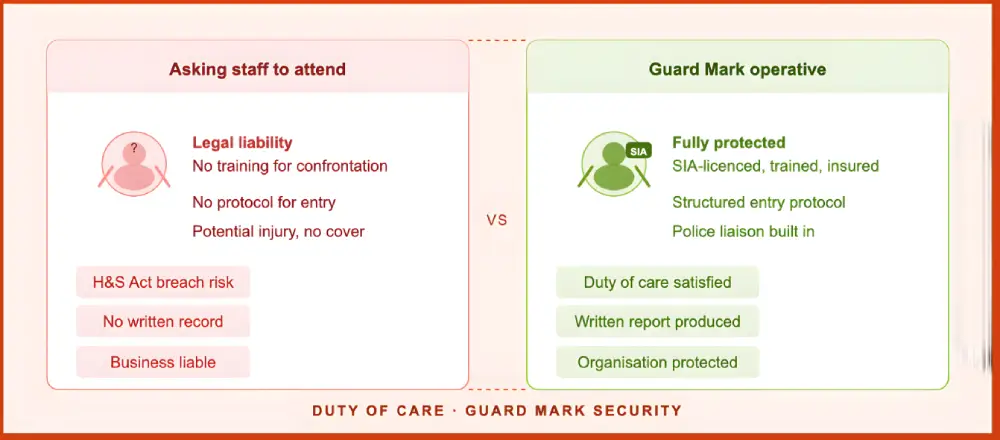
When a property manager is the keyholder and something goes wrong during an out-of-hours attendance, the personal liability exposure is direct. If a guard from a professional, SIA-licenced provider attends and something goes wrong, the liability framework sits with the company and its insurance, not with the property manager personally.
This distinction matters more than most property managers realise until they are in a situation where it counts. A keyholding security company carries public liability insurance, employs operatives under professional obligations, and operates within a regulatory framework that individual keyholders simply do not have access to.
Guard Mark Security carries full public liability insurance and holds SIA Approved Contractor status. For property managers who want professional cover rather than personal exposure, call 03301755786 or email [email protected].
What Does Professional Documentation Mean for Property Management Compliance?
Every attendance by a professional keyholder produces a written incident report. That report records the activation time, the response time, the findings from the external and internal check, any action taken, and the final secured status of the premises. For property managers, this documentation serves several important functions:
-
It provides evidence of due diligence if a tenant or property owner queries how an incident was handled
-
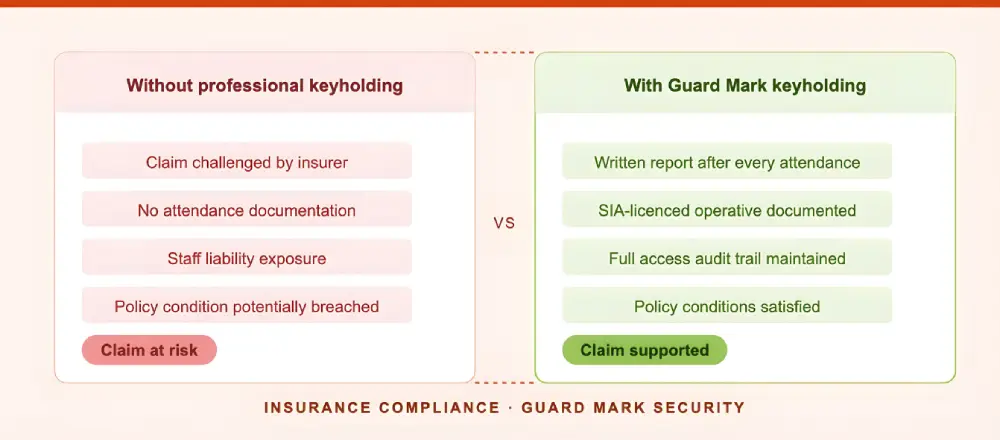
It satisfies insurer requirements for documented attendance records
-
It builds a chronological record of activity at each managed property over time
-
It demonstrates to property owners that their assets are being managed with professional oversight
In-house keyholding arrangements typically produce none of this documentation. The property manager attends, resets the alarm, and goes home. Nothing is recorded. That absence becomes a problem if questions are ever asked later about what was done and when.
How Does a 24/7 Keyholding Service Handle Portfolio Coverage?
For property managers covering multiple sites, a 24/7 keyholding service provides something that no individual or small internal team can match: guaranteed coverage across the entire portfolio simultaneously, regardless of time, geography, or how many activations occur at the same time.
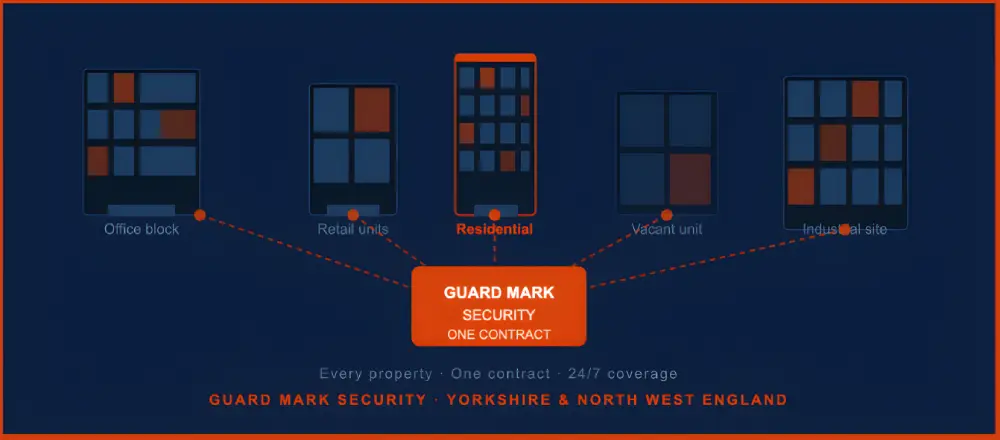
Guard Mark Security structures portfolio keyholding arrangements so every property in the managed portfolio has the same contractually guaranteed response times, the same professional attendance standard, and the same documentation output. Coverage does not degrade when the property manager is travelling, on holiday, or simply unavailable.
What Specific Scenarios Make Outsourcing the Right Decision?
Beyond the structural arguments for outsourcing, there are specific operational scenarios that consistently push property managers toward making the switch. Recognising these situations before they occur helps property managers act proactively rather than reactively.
Does Managing Vacant Properties Require a Different Approach?
Vacant properties represent the highest-risk category in most property management portfolios. No occupier activity to deter intrusion. No one to notice unusual access or suspicious presence. A clear signal to anyone watching the site that the building is unoccupied.

The risks that concentrate around vacant commercial properties include:
-
Theft of copper, metal, and any remaining fixtures or fittings
-
Unauthorised occupation and squatting
-
Criminal damage and vandalism
-
Arson, both opportunistic and deliberate
-
Fly-tipping on commercial land, which creates enforcement exposure for the property manager
A professional keyholding security company covers vacant properties through a combination of alarm response and mobile patrol visits. Guard Mark Security’s mobile patrols visit sites at randomised intervals, provide GPS-verified attendance records, and report any concerns immediately. For property managers, this turns the highest-risk period in the property lifecycle into one with documented, professional oversight.
How Should Emergency Out-of-Hours Access Be Handled?
Emergency access requests outside business hours are a recurring operational challenge. A tenant locked out. A maintenance contractor responding to an urgent issue. A utility provider dealing with a gas or water emergency. Each of these requires someone with authorised access to attend quickly and professionally.
Without outsourced keyholding, these requests fall to the property manager, often at inconvenient times and with no documentation of what occurred. With Guard Mark Security’s keyholding services in place, emergency access is handled by a licenced, vetted operative who can attend within a defined response window, with a full record of the access produced afterwards.
This removes the risk of keys being handed informally to contractors or tenants in response to urgent situations, which creates exactly the kind of undocumented access vulnerability that professional key management is designed to prevent.
Guard Mark Security handles emergency access requests as part of the keyholding service. If you are currently managing these calls yourself, we can take them over. Call 03301755786 or email [email protected].
What Changes at Tenancy Handover Make Professional Cover Essential?
The period between tenancies is operationally complex from a security perspective. Keys may not all be returned by the outgoing tenant. Access codes may not have been changed. Physical damage from the previous tenancy may have left locks or entry systems compromised. The property may sit vacant for weeks before a new occupier moves in.
Each of these factors creates after-hours risk that a property manager without professional keyholding support has to manage personally. With outsourced alarm response services and patrol cover in place, the handover period is protected by the same professional standard as any other phase of the property’s lifecycle.
What Should Property Managers Look for When Choosing a Keyholding Security Company?
Not every keyholding provider is equipped to handle the specific demands of property management. The right provider understands multi-site portfolios, can work across multiple property types, and produces the documentation that property management compliance requires. Choosing based on price alone consistently produces poor results.
What Accreditation and Licencing Should the Provider Hold?
The minimum standard for any keyholding security company is SIA Licencing for all operatives. This is a legal requirement under the Private Security Industry Act 2001 and is publicly verifiable on the SIA register. Beyond individual Licencing, all operatives accessing managed properties should be BS7858 vetted, covering criminal record checks, five-year employment history verification, and identity confirmation.
At company level, SIA Approved Contractor status confirms the provider has passed independent audits of their management and compliance standards. Guard Mark Security holds this accreditation and confirms it in writing for every client.
How Should the Contract Be Structured for a Property Portfolio?
A keyholding contract for a property management portfolio should cover several specific points:
-
Contractually binding response times confirmed for each individual property address
-
Clear protocols for different property states, occupied, vacant, and transitional
-
Incident reporting requirements and delivery timescales after every attendance
-
Key storage standards and the access audit process for each property
-
How emergency access requests outside the standard alarm response process are handled
Property managers who accept a generic contract designed for single-site businesses often find that the arrangement does not reflect the complexity of managing multiple properties. Guard Mark Security builds portfolio-specific contracts that reflect the real operational demands of property management.
Related guides from Guard Mark Security
→ What happens when a commercial alarm is triggered? — A step-by-step guide to the full response chain, from activation to written report. Read the full guide
→ Keyholding and alarm response checklist — Everything to verify before you hand your keys to any security company. Download the checklist →
→ 24/7 keyholding and alarm response services — Our full service overview, pricing, and coverage areas across Yorkshire and North West England. View our services →
Frequently Asked Questions-FAQs
What is keyholding for property managers?Keyholding for property managers is a professional security arrangement where a licenced security company holds a secure set of keys to your managed properties and responds immediately whenever an alarm activates, an emergency occurs, or out-of-hours access is required. Instead of relying on staff, tenants, or contractors to attend unpredictable security incidents — often in the middle of the night — you have a trained, SIA-licenced operative on standby for every one of your properties, 24 hours a day, 7 days a week. Guard Mark Security provides keyholding across Yorkshire and North West England, with contractually confirmed response times for every property address on your portfolio.
Does my property insurance require professional keyholding?
It depends on your policy, but increasingly yes — particularly for commercial premises, vacant properties, and high-value portfolios. Many UK insurers now require a formal keyholding arrangement to be in place as a condition of coverage, especially for out-of-hours alarm response. Even where it is not an explicit policy requirement, having a professional keyholding company in place — with written incident reports after every attendance — significantly strengthens any insurance claim following a break-in or security incident.
An informal arrangement where a member of staff was called but didn’t attend, or attended without any documented record, gives insurers grounds to challenge a payout. We recommend checking your policy wording directly for “keyholder” or “alarm response” conditions, and contacting Guard Mark if you need a professional arrangement in place quickly.Can one keyholding company cover all my properties?
Yes — and for property managers with multiple sites, a single keyholding provider covering your entire portfolio is far more efficient and reliable than separate arrangements for each location. Guard Mark Security covers commercial offices, residential blocks, retail units, industrial premises, and vacant properties across Yorkshire and North West England under a single contract. Each property gets its own response protocol, its own written incident reports, and contractually confirmed response times for its specific address. You get one point of contact, one invoice, and one documented security arrangement across every property you manage — which is exactly what your insurer and your landlord clients want to see.
Is it legal to ask staff to attend alarm activations?
There is no specific law that prevents you from asking a member of staff to attend an alarm activation, but doing so creates significant legal liability under your duty of care obligations as an employer. Under the Health and Safety at Work Act 1974, employers must protect employees from foreseeable risks where it is reasonably practicable to do so. Sending an untrained person alone to a premises where an intruder may still be present is a foreseeable risk. Professional keyholding — available from under £3 per day — is a proportionate, readily available alternative. If a staff member is injured attending a property on your instruction, and you had not taken reasonable steps to avoid that risk, you face both civil and potential regulatory consequences. Outsourcing to Guard Mark removes this risk entirely.
How much does keyholding cost for property managers in Yorkshire?
Guard Mark Security’s keyholding service starts from £2.50 per day per property, covering 24/7 alarm response, SIA-licenced operatives, secure key storage, and written incident reports after every attendance. For property managers with multiple sites across Yorkshire and North West England, portfolio pricing is available — contact the team directly for a quote tailored to your number of properties and specific locations. There are no hidden fees and no long-term lock-in requirements. The cost of professional keyholding is almost always significantly lower than the cost of a single unmanaged security incident, an invalid insurance claim, or the legal liability arising from asking staff to attend a property unsupported.
What happens when an alarm activates at one of my managed properties?
The moment your alarm activates, the signal reaches our monitoring centre and a Guard Mark operative is dispatched immediately — no callback loop, no delay. The operative conducts a full external perimeter check on arrival: all access points, signs of forced entry, condition of external CCTV and alarm equipment. If anything raises concern, police are contacted before any entry is made. Once the perimeter is confirmed clear, an internal sweep is completed and the property is fully secured before the operative leaves. You receive a written incident report covering activation time, response time, findings, any police contact, and the final status of the premises — automatically, after every single attendance.
Do you provide keyholding for vacant properties?
Yes — vacant properties are among the highest-risk premises in any property portfolio, and they are the sites most likely to have specific insurance requirements attached. Guard Mark Security provides full keyholding and alarm response for vacant commercial and residential properties across Yorkshire and North West England, including written visit reports that satisfy most insurer requirements for vacant property coverage. Empty premises that have a professional keyholding arrangement in place — with documented attendance records — are demonstrably lower risk to insurers than those without. Contact Guard Mark to discuss your vacant property requirements and get a quote for your specific addresses.
Why Do Property Managers Choose Guard Mark Security?
Guard Mark Security has provided professional keyholding service and out-of-hours security cover for property managers across Yorkshire and North West for over a decade. The service is built around the specific needs of managed property portfolios rather than individual owner-occupied businesses.
Every operative is SIA licenced and BS7858 vetted. Guard Mark holds SIA Approved Contractor status and carries full public liability insurance. Keyholding and alarm response starts from £2.50 per day per property, with alarm response included as standard and no hidden callout fees.
Property managers who work with Guard Mark Security gain consistent professional cover across every property in their portfolio, written documentation after every attendance, and the removal of personal after-hours liability that comes with handling keyholding in-house.
The question is not whether outsourcing keyholding is the right decision. For most property managers, it clearly is. The question is whether you do it before something happens or after it.
Call Guard Mark Security on 03301755786 or email [email protected]. We provide free portfolio assessments, confirm response times for each of your managed properties, and build keyholding arrangements that work for the way property management actually operates.