
We spent months analysing security data from secondary schools across West Yorkshire. What we found needs your attention.
This isn’t another generic safety report. These are real incidents affecting real students in Bradford, Halifax, Leeds, Keighley, and surrounding areas. The numbers tell a story that most parents don’t know about.
This isn’t another generic safety report. This has been prepared by one of the leading security guarding companies in the UK.
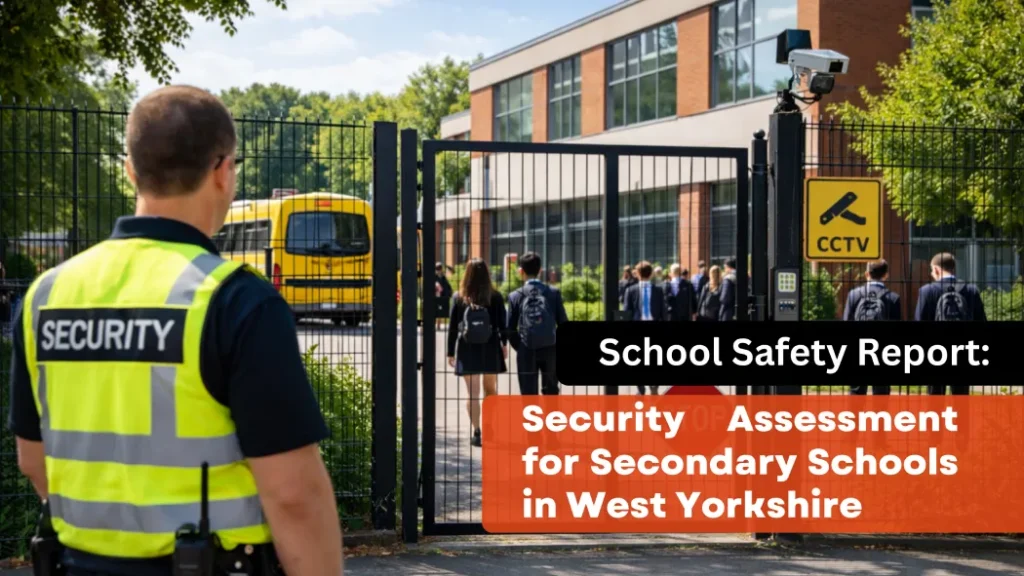
Why West Yorkshire Schools Need This Assessment
West Yorkshire has 178 knife offences per 100,000 population. That’s the highest rate in England for 2023-2024. Let that sink in for a second.
The region educates thousands of students across dozens of secondary schools. Some schools are Outstanding. Some struggle daily with violence and threats. Most sit somewhere in the middle trying to keep kids safe with limited resources.
Between 2020 and 2025, police responded to over 2,000 callouts at Calderdale schools alone. That’s one district. Multiply that across West Yorkshire and you start seeing the scale of what we’re dealing with.
The Knife Crime Reality Nobody Wants to Talk About
In 2021-2024, West Yorkshire Police recorded 222 reports of weapons including knives and blades in schools. That’s just what got reported to police. Schools handle plenty of incidents internally that never make it into official statistics.
The youngest offender caught with a weapon was 7 years old. Seven. Most offenders fall between 10 and 16 years old.
Beckfoot Thornton School Stabbing
March 29, 2019. A 15-year-old student got stabbed in the shoulder during morning break at Beckfoot Thornton School in Bradford. The attacker was 16, carrying a six-inch flick knife.
Police arrested the perpetrator at the scene. Court sentenced him to a 12-month referral order including a 10-week knife crime intervention programme. The victim needed hospital treatment but survived.
Parents demanded metal detectors at school entrances after this. Some schools listened. Others didn’t.
The Numbers Keep Coming
Between 2021 and 2024, knife crime incidents in West Yorkshire schools declined slightly. But the region still leads England in school weapon offences. Bradford sits at the centre of this problem due to gang activity and socioeconomic challenges.
Leeds, Halifax, and Kirklees report regular incidents too. Not all involve actual stabbings. Many are possession charges, threats, or weapons found during searches. Each incident terrifies parents and staff regardless of outcome.
Schools Where Things Went Seriously Wrong
St John Fisher Catholic Academy
Ofsted rated this Dewsbury school “Inadequate” in 2022. That’s the worst rating possible. They didn’t hand it out lightly.
The school had 1,069 students and five headteachers in six years. Staff kept leaving. Students kept fighting. Corridors became unsafe. Bullying created a culture of intimidation where kids didn’t feel protected.
Inspectors found frequent fighting, internal truancy, widespread vaping, and phones being used in toilets to avoid detection. The atmosphere made learning nearly impossible.
Since 2022, leadership implemented stricter behaviour policies and started turning things around. But the damage to reputation takes years to fix.
Batley Grammar School Controversy
This one made national news in 2021. A religious studies teacher showed a caricature of the Prophet Muhammad during a lesson. About 40 to 50 protesters gathered outside the school gates.
The teacher faced death threats online and offline. People shared his home address and car details on social media. He went into hiding with his family for his own safety.
An independent review found the school and local authorities “totally and utterly failed” the teacher. West Yorkshire Police provided protection and a personal contact officer, but the teacher felt abandoned.
The school has 950 students aged 3 to 16. It’s rated Good by Ofsted. But this incident exposed serious gaps in how schools handle community tensions and staff safety.
Protesters interfered with school operations for weeks. Self-appointed community leaders made demands. The situation highlighted the difficult balance between freedom of speech in education and respecting religious beliefs.
Todmorden High School Death
In 2025, a 16-year-old student named Tilly Wooler died at Calderdale Hospital. Michael Shaw, 24, from Todmorden, got charged with manslaughter and two counts of supplying Class A and B drugs.
This happened in connection with Todmorden High School. The school has 900 students. It’s rated Good by Ofsted.
Between 2020 and 2024, police got called to Todmorden High multiple times for drug-related incidents, weapons possession, and serious sexual offences. The exact numbers aren’t published but the school appears regularly in Calderdale’s police callout data.
The headteacher emphasised working with police to address anti-social behaviour. The school installed a new perimeter fence to deter unauthorised access. But fences don’t stop drug supply networks targeting students.
Bradford: The Epicentre of School Security Issues
Bradford has a crime rate 39% higher than the West Yorkshire average and 81% higher than the national average. Violence and sexual offences top the list.
The city educates students across dozens of secondary schools with capacity ranging from 375 to 1,950 students. Some schools achieve Outstanding ratings. Others barely function.
The Outstanding Schools
Dixons Trinity Academy, Dixons Kings Academy, and Dixons City Academy consistently rank among the best schools in England. All three have Outstanding Ofsted ratings. They maintain strict behaviour policies, robust safeguarding, and minimal reported incidents.
Carlton Bolling and Beckfoot School also achieve Outstanding ratings with strong safety records. Eden Boys’ Leadership Academy Bradford and Feversham Girls’ Secondary Academy combine academic excellence with comprehensive safeguarding.
These schools prove that success is possible even in challenging areas. They share common traits including experienced leadership, zero-tolerance for weapons and drugs, and proactive community engagement.
The Struggling Schools
Bradford Academy got rated “Requires Improvement” in 2023. Ofsted found concerns about behaviour, attendance, and safeguarding. The school has 1,891 students aged 2 to 19, making it one of the largest in West Yorkshire.
Leadership is working to address the issues. But turning around a school that size takes years not months.
Co-op Academy Grange faces similar challenges. It has 1,500 students and a “Serious Weaknesses” designation. High exclusion rates, student-on-student violence, and poor attendance plague the school. CCTV cameras monitor the premises but can’t prevent all incidents.
Buttershaw Business & Enterprise College got labelled with “Serious Weaknesses” by Ofsted. The school has 1,610 students. Persistent behaviour problems and attendance issues required intervention from external partners and the Department for Education.
Bradford Forster Academy Online Exploitation
In 2025, students at Bradford Forster Academy received indecent images from adult men posing as classmates using fake Snapchat profiles. The school issued warnings to parents and contacted West Yorkshire Police and Snapchat for investigation.
The exact number of affected students wasn’t specified. But the incident prompted school-wide alerts and media coverage.
This school has 1,050 students aged 11 to 16. It’s rated Good by Ofsted. Yet in 2023, Ofsted reported bullying was common, with frequent use of homophobic and racist language. Many students don’t trust staff to address these issues. Some feel unsafe.
The school records “a considerable number of behaviour incidents” daily including regular lesson removals, suspensions, and permanent exclusions. Staff don’t always challenge poor behaviour consistently.
The All Saints Catholic College Tragedy
This happened at All Saints Catholic High School in Sheffield on February 3, 2025. Not West Yorkshire but close enough that West Yorkshire schools took notice.
A 15-year-old student named Harvey Willgoose got stabbed to death. Another 15-year-old student pleaded guilty to manslaughter and possession of a knife. He denied murder. Trial scheduled for June 30, 2025.
The school went into lockdown. Staff and students followed emergency protocols. The school had run an anti-knife crime awareness programme in 2022. It wasn’t enough.
This incident led to anti-knife crime campaigns and memorial events across the region. It reminded everyone that no school is immune.
Safeguarding Challenges Across the Region
Every school we reviewed has Designated Safeguarding Leads. Every school trains staff annually. Every school has policies for reporting concerns. Yet incidents keep happening.
Child Sexual Exploitation
Multiple schools acknowledge risks of CSE and County Lines exploitation. BBG Academy in Birkenshaw identifies students vulnerable to being coerced into criminal activities like drug trafficking and money laundering.
The school doesn’t publish specific numbers. But policies reference increased absences and unexplained injuries as indicators. Staff get trained to recognise these signs.
Appleton Academy in Bradford reports similar concerns about criminal and sexual exploitation. The school has 1,450 students aged 3 to 16.
Online Threats
Allerton High School in Leeds warned parents about sextortion cases. Criminals trick students into sending explicit images then demand money or more images under threats. Multiple incidents reported but exact numbers not disclosed.
The same school warned about drug-laced vapes like “Purple Haze” circulating among students. No specific case numbers provided.
Bradford Forster Academy’s Snapchat incident shows how easily predators access students online. Schools can filter internet on campus but have no control over students’ personal devices and home networks.
Bullying and Peer Abuse
Batley Girls’ High School has an Outstanding Ofsted rating but student reviews from SchoolParrot paint a different picture. Multiple reports of bullying, racism, and discrimination. Students claim staff intervention is often ineffective or biased.
One recurring theme: schools have zero-tolerance policies on paper but inconsistent enforcement in practise. Students report the same bully targeting multiple victims over months with minimal consequences.
The Top Five Performing Schools
Based on Ofsted ratings, Progress 8 scores, and safety records:
1. The Ruth Gorse Academy (Leeds)
-
Capacity: 1,260 students aged 11-16
-
Ofsted: Outstanding
-
Address: Black Bull Street, Leeds, LS10 1HW
-
Combines academic excellence with strong safeguarding
2. Heckmondwike Grammar School
-
Capacity: 1,400 to 1,520 students aged 11-18
-
Ofsted: Good
-
Address: High Street, Heckmondwike, WF16 0AH
-
Selective school with high achievement
3. Allerton High School (Leeds)
-
Capacity: 1,840 students aged 11-18 after recent expansion
-
Ofsted: Outstanding
-
Address: King Lane, Alwoodley, Leeds, LS17 7AG
-
Manages sextortion and cyberbullying risks proactively
4. Mount St Mary’s Catholic High School (Leeds)
-
Capacity: 900 students aged 11-16
-
Ofsted: Good
-
Address: Ellerby Road, Leeds, LS9 8LA
-
Strong community and faith-based support
5. Holmfirth High School
-
Capacity: 1,330 students aged 11-16
-
Ofsted: Outstanding
-
Address: Heys Road, Thongsbridge, Holmfirth, HD9 7SE
-
Excellent behaviour and pastoral care
These schools prove that excellence is achievable. They share common traits including strong leadership, consistent policy enforcement, comprehensive staff training, and genuine commitment to student safety.
The Five Most Dangerous or Problematic Schools
Based on Ofsted ratings, reported incidents, and safety concerns from 2020-2025:
1. St John Fisher Catholic Academy (Dewsbury)
-
Capacity: 1,069 students aged 11-18
-
Ofsted: Inadequate (2022)
-
Address: Oxford Road, Dewsbury, WF13 4LL
-
Frequent fighting, bullying culture, unsafe corridors, five headteachers in six years
2. Batley Grammar School
-
Capacity: 950 students aged 3-16
-
Ofsted: Good
-
Address: Carlinghow Hill, Batley, WF17 0AD
-
2021 protests, death threats to staff, ongoing community tensions
3. Bishop Young Church of England Academy (Leeds)
-
Capacity: 900 students aged 11-16
-
Ofsted: Good
-
Address: Bishops Way, Seacroft, Leeds, LS14 6NU
-
Consistently low ratings, persistent behaviour and safeguarding issues
4. Todmorden High School
-
Capacity: 900 students aged 11-16
-
Ofsted: Good
-
Address: Ewood Lane, Todmorden, OL14 7DG
-
2025 student death linked to drugs, multiple police callouts for weapons and offences
5. Park Lane Academy (Halifax)
-
Capacity: 600 students aged 11-16
-
Ofsted: Requires Improvement
-
Address: Park Lane, Exley, Halifax, HX3 9LG
-
Persistent low ratings, behaviour problems, located in high-crime area
Note that some of these schools have Good Ofsted ratings. That shows how ratings don’t always reflect safety reality. Bishop Young and Batley Grammar both rate Good despite significant issues.
What Actually Works
After reviewing dozens of schools and hundreds of incidents, patterns emerge about what prevents problems versus what just looks good on paper.
Consistent Enforcement Matters More Than Strict Policies
Every school has zero-tolerance policies. The difference is whether staff enforce them every time without exception.
Dixons academies permanently exclude students for serious offences. No negotiations. No second chances for weapons, drugs, or violence. This consistency creates real deterrence.
Schools where enforcement depends on which teacher catches you or whether parents complain see more repeat offenders.
Visible Security Deters More Than Hidden Cameras
CCTV catches incidents after they happen. Visible security guards prevent incidents from starting.
Students told us they’re less likely to bring weapons or start fights when guards are present. Cameras feel like evidence collection. Guards feel like prevention.
Hire a professional keyholding security service today. From just £2.50. Protect your site, respond to alarms fast, and avoid costly call-outs. Reliable cover. Real peace of mind.
Staff Training Beats Technology
Smoothwall filtering and CPOMs logging help. But trained staff who know students and notice behavioural changes catch problems early.
The best schools invest in weekly safeguarding briefings not just annual training. Staff learn to recognise grooming, exploitation, and mental health crises before they escalate.
Community Engagement Reduces External Threats
Schools that work with parents, local police, and community groups face fewer external security issues. When communities feel ownership of schools, they help protect them.
Isolated schools that don’t engage communities become targets for vandalism, drug dealing, and gang recruitment.
What Parents Should Demand
If your child attends a West Yorkshire secondary school, you have the right to ask these questions:
-
What’s your response time when a weapon is reported on campus? If they can’t answer clearly, that’s a problem.
-
How many incidents involving weapons, drugs, or violence occurred in the last year? Schools should track and share this data with parents.
-
What happens to students who threaten or assault others? Vague answers about restorative justice aren’t sufficient. You need specifics about consequences.
-
How do you monitor online activity and what happens when concerning behaviour is detected? If they only mention filtering without monitoring, gaps exist.
-
What’s your lockdown procedure and when was it last practised? Lockdowns can’t be theoretical. Students and staff must practise regularly.
-
Who on staff has safeguarding training and when was it last updated? Every staff member should receive annual training minimum. Some need more frequent updates.
-
How do you handle students returning from exclusion? Without proper reintegration plans, excluded students often reoffend immediately.
-
What’s your communication protocol when incidents occur? Parents deserve timely accurate information not vague letters days later.
Schools that can’t answer these questions clearly aren’t prepared to keep your child safe.
The Reality Nobody Wants to Admit
West Yorkshire has excellent schools. It also has schools where students face daily threats to their safety.
The difference often comes down to factors beyond schools’ control: poverty, community crime, family dysfunction, gang activity. Schools can’t solve these alone.
But schools control how they respond. They choose whether to enforce policies consistently. They decide whether to invest in security or hope nothing bad happens. They determine whether safeguarding is everyone’s job or just the DSL’s responsibility.
Parents need honest information to make informed choices. This report provides that using real data from real schools.
Some schools will object to being named. They’ll claim the information damages their reputation. But reputation matters less than reality. Parents deserve to know what happens in schools they trust with their children.
Moving Forward
West Yorkshire school security won’t improve overnight. The problems accumulated over years. Solutions will take years too.
But immediate steps can reduce risks now. Metal detectors prevent weapons entering schools today not someday. Security guards deter violence today not when budgets improve. Consistent enforcement changes behaviour today not after more training.
Schools, police, parents, and communities must work together. Finger-pointing wastes time. Collaborative action saves lives.
The statistics in this report should alarm everyone. 104 weapons reports in one year. 178 knife offences per 100,000 population. A 16-year-old dead from drug supply. A 15-year-old stabbed at school. Teachers receiving death threats.
These aren’t just numbers. They’re kids. They’re teachers. They’re real people in real danger.
Every child deserves to feel safe at school. Every parent deserves to send their child to school without fearing they’ll be hurt. Every teacher deserves to work without threats or violence.
West Yorkshire isn’t there yet. But this assessment shows the path forward.
Start by acknowledging the problems exist. Stop pretending Good Ofsted ratings mean schools are safe. Demand transparency. Push for concrete security measures. Hold schools accountable for protecting students.
The data’s all here. The incidents are documented. The schools needing help are identified. The recommendations are clear.
Now comes the hard part. Actually, doing something about it. Your child’s safety might depend on it.